The worst thing in a janitor cabinet? Clutter.Wet towels piled on shelves. Mops leaning sideways against the door. Brushes scattered on the floor where people step on them. Spray bottles crammed together so you can’t grab one without knocking over two.This cabinet fixes the clutter. A drying rod runs across the middle. Hooks line the side panel. Wet stuff hangs and dries. Dry stuff has a designated spot. Open the door, see everything, grab what you need, close it.
Piling vs hanging, there’s a real difference
Here’s what happens in most janitor rooms. After a shift, the mop goes back in the cabinet wet. If it leans against the wall or sits on a shelf, the head never really dries. Next morning it smells. By the third day the whole cabinet stinks. By the end of the month that mop head needs replacing.
Towels are worse. Ball them up wet on a shelf and they stay wet. Fold them, same thing — no airflow between layers. You could leave them for a week and the center would still be damp. That’s where the sour smell comes from.
Hang them. That’s the whole difference.
A wet towel draped over a rod has air moving across it from above, below, and both sides. It dries overnight. A mop suspended from a hook has its head hanging in open air. Two hours and it’s dry. No sour smell. No mildew. No replacing tools every other month because they rotted in a pile.
It sounds too simple to matter. Until you’ve smelled a janitor room where nothing dries.
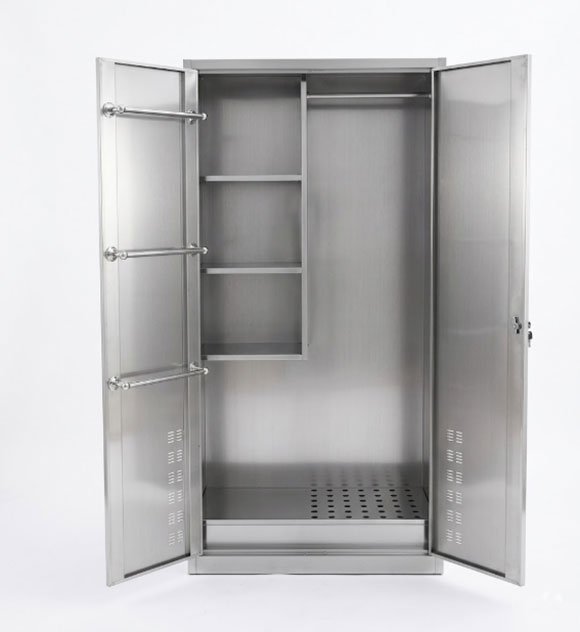
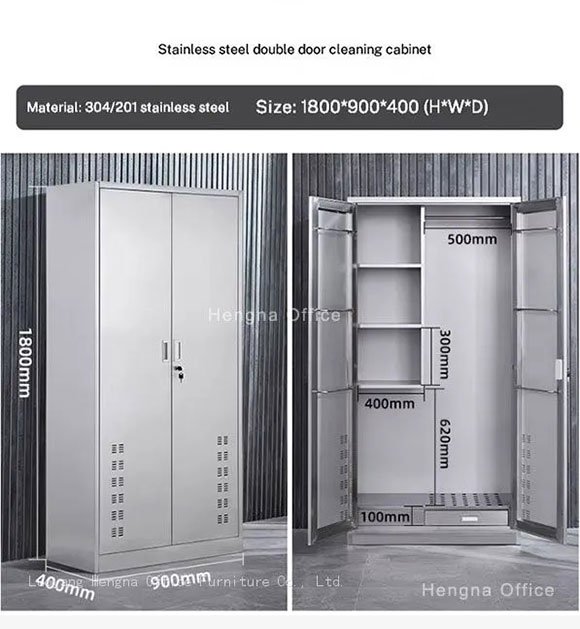
Janitor Cabinet with Drying Rod and Hooks, 201 SS Specs
| Item | Spec |
|---|---|
| Material | 201 stainless steel |
| Dimensions | W500 × D400 × H1800mm (with feet) / H1690mm (body) |
| Door | Double door, key lock |
| Shelf spacing (top to bottom) | 300 / 380 / 350 / 100mm |
| Drying rod | Stainless steel bar for towels, gloves, rags, sponges |
| Hooks | Multiple side panel hooks for mops, brooms, brushes, spray bottles |
| Drainage | Optional bottom drain hole + drip tray |
| Lock | Steel cylinder |
How the rod and hooks work, in practice
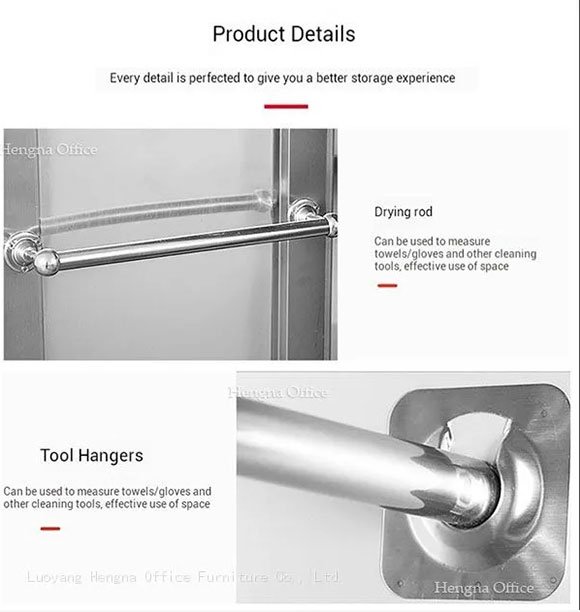
The drying rod is a solid stainless bar fixed across the middle section of the cabinet. It’s not a flimsy tension rod that slides out of place. It’s mounted. You can hang three or four wet towels across it without sagging. There’s enough space between the rod and the shelf above so towels don’t touch — full air circulation.
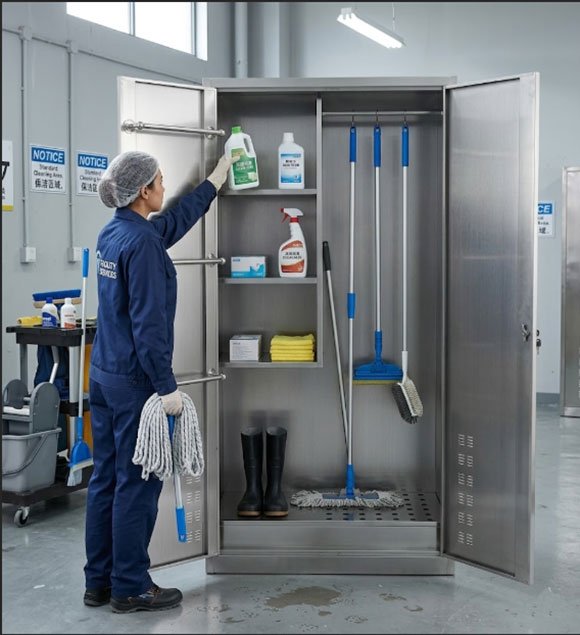
The side panel hooks are installed vertically. Here’s a typical setup that our clients land on after a week or two:
Top hook: mop, head suspended. Middle hook: broom or long-handled scrub brush. Bottom hooks: spray bottles and dustpan. The lower shelf still has room for stored supplies — the hooks don’t eat into shelf space because they’re on the side wall.
A property management client in Australia ran their janitor room with no organization for years. Cabinet was basically a metal box. Mops leaned against the wall. Brooms fell over constantly. Towels got tossed onto whatever shelf was closest. After they installed this cabinet with the rod and hooks, their lead cleaner told us something that stuck: “I used to spend five minutes every morning just untangling the mess. Now I open the door and everything is right there.”
The floor cleared up too. Once tools were on hooks, the cabinet footprint didn’t change but the usable floor space around it doubled. They could actually mop the entire room without working around things on the ground.
Setting up hooks based on workflow
One thing nobody tells you: hook placement changes how fast a room gets cleaned.
If you hang the mop at the front of the cabinet and the spray bottles at the back, your cleaner reaches past everything twice per shift. Move the most-used items to the front hooks. Mop and spray bottle first. Specialty brushes that get used once a week can go further back.
For teams sharing a cabinet, assign hook zones. Left side: morning shift. Right side: evening shift. Everyone knows where their tools live. Nobody grabs the wrong mop. Sounds minor. Over a year, it eliminates dozens of “who took my broom” conversations.
Is 201 stainless enough for the rod and hooks
Short answer: yes, for normal wet environments.
The rod and hooks are the same 201 stainless as the cabinet body. Wet towels on the rod don’t cause rust because the rod surface is smooth with nowhere for water to pool. Towels dry within hours. Moisture exposure is brief, not constant.
In our experience, clients in hotels, schools, property management, and gyms get 8-10 years out of the 201 rod and hooks with zero rust. The key is that water doesn’t sit — it evaporates.
If your facility uses bleach or strong disinfectants daily — hospitals, food processing plants, labs — have us upgrade the rod and hooks to 304 stainless. The extra nickel content handles chemical exposure. There’s a price difference. Worth it for those environments, overkill for standard ones.
Where rod and hooks make the most difference
Hotel housekeeping. Cleaning carts return at end of shift. Different floor towels, bathroom towels, and dusting cloths go on separate sections of the rod. No cross-contamination. Hooks hold the mop, broom, and extension duster. Housekeeping supervisor can glance in and see if anything is missing.
Schools and universities. Five janitors, one cabinet, summer deep-clean plus daily maintenance. Rod holds bulk rags that all of them use. Hooks give each person a designated spot for their assigned mop and broom. Nothing gets mixed up.
Factory and warehouse floors. Tools vary wildly in size. Industrial push brooms are three feet wide. Small detail brushes are six inches. Hooks handle both — big tools on top hooks, small ones below. The rod holds oil rags and cleaning cloths that need to dry between shifts.
Gyms and fitness centers. Towel turnover is brutal. Wet towels come off the floor every hour during peak times. The rod holds six to eight gym towels at once — hang them, they dry, they’re ready for the next rotation. Hooks keep the spray bottles of gym wipe solution separated from floor cleaner.
Swimming pools and aquatic centers. Humidity sits at 90% or higher year-round. Tools stacked on shelves in that environment grow mold fast. Suspended on hooks in open air inside the cabinet, they dry three times faster. Stainless hooks in pool areas hold up. Plastic hooks in the same environment turn brittle in under a year.
Restaurant and commercial kitchens. Color-coded cloth systems are standard: red for raw meat areas, blue for general wiping, green for front-of-house. Each color gets a section of the drying rod. No mixing. Health inspector walks in, sees the system, checks the box. Hooks hold the deck brush for floors and the smaller pot brush — separate, because a pot brush should never touch the floor.
Standard features worth mentioning
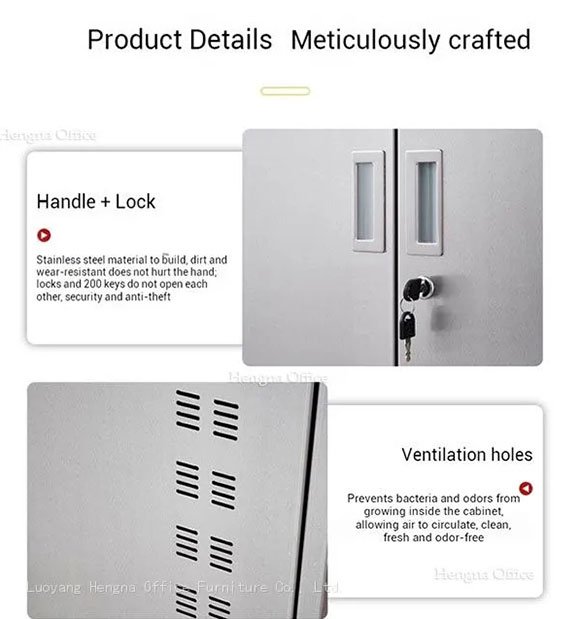
The lock is steel cylinder, anti-pry. It’s standard. You’re not paying extra for basic security.
Bottom drainage is available as an option. If your mops drip heavily, add the drain hole and removable drip tray. Water drains out instead of pooling. Combined with the rod and hooks, water has two exit paths: evaporation from hanging tools, and drainage from oversaturated ones.
The cabinet ships fully assembled. No flat-pack frustration. Unload it, wheel it to the janitor room, it’s ready.
Questions people ask before ordering
Q: How much weight can the drying rod hold? A: It’s solid stainless steel, mounted on both ends. Three or four soaking wet towels — no problem, no bending. Don’t hang buckets from it. That’s what the hooks are for.
Q: Will the hooks come loose over time? A: They’re fixed-mounted into the cabinet body, not adhesive or suction. Under normal use — hanging mops, brooms, brushes, spray bottles — they won’t budge. We’ve had zero reports of hook failure across thousands of units.
Q: Will constant wet towel contact rust the rod? A: 201 stainless, standard wet environment, the rod won’t rust. The surface is polished smooth. No crevices for water to sit. Towels dry within hours. We see 8-10 years of rust-free use in hotels, schools, and gyms. Chemical-heavy environments like hospitals should upgrade to 304.
Q: Can I add more hooks or move them? A: Yes. The standard setup is one vertical row on the side panel. If you need more hooks or different spacing, tell us at order time. We configure before shipping.
Q: Do you ship internationally? A: Yes. Sea freight packaging includes moisture-proof wrap, corner protectors, and reinforced crating. Cabinets arrive in good condition based on our shipping records.
Q: What’s the minimum order? A: Samples: 1 unit. Bulk pricing starts at 10+ units. Contact us for a quote with your quantity and destination.
About us
Luoyang Hengna Office Furniture Co., Ltd. 9 years in steel furniture. The number one complaint we’ve heard from janitorial teams over the years: “There’s nowhere to hang anything in this cabinet.” So we made the rod and hooks standard. Not an upsell. Not an accessory kit. Just how the cabinet should come.
We work directly with our production base. Pricing skips the middleman. Products ship worldwide. CE certified. OEM available for custom logos, packaging, and sizing.
Need a quote? Send your quantity and shipping destination. We respond within 24 hours.