Cold storage puts shelving through conditions most warehouses don’t see — sub-zero temperatures, high humidity, constant condensation from door openings, and frequent washdowns. Ordinary steel racks look fine for the first few months. Then rust starts at the weld joints, bolt holes, and cut edges. Not surface rust — corrosion that eats through from the inside.
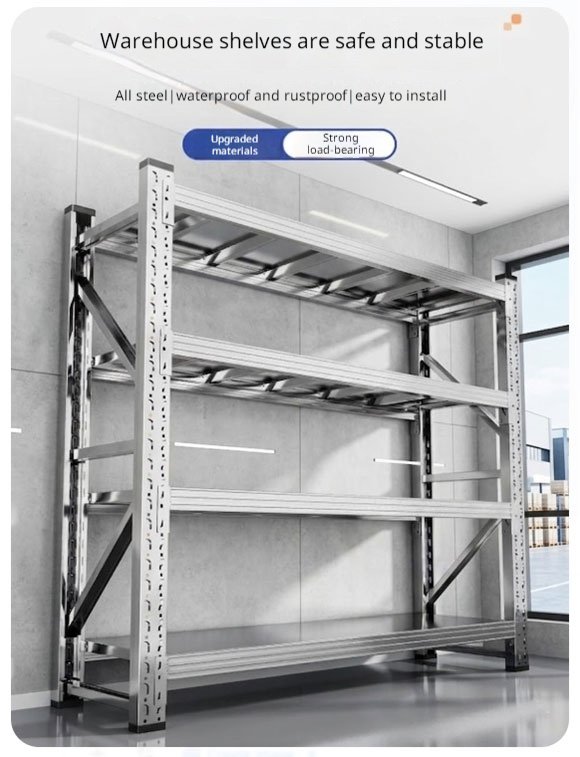
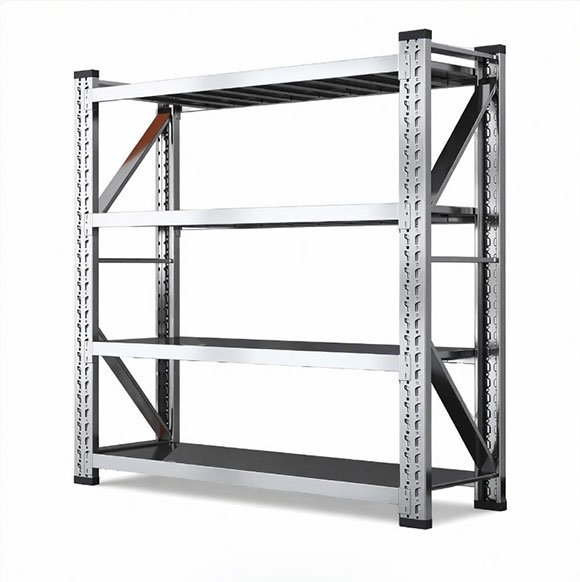
This 4-tier shelving unit uses 304 stainless steel. No paint, no coating. The corrosion resistance goes all the way through the material. Each shelf has welded reinforcement ribs underneath to prevent sagging under heavy frozen loads. The frame uses butterfly snap connectors — push in to lock, push out to release. No tools required.
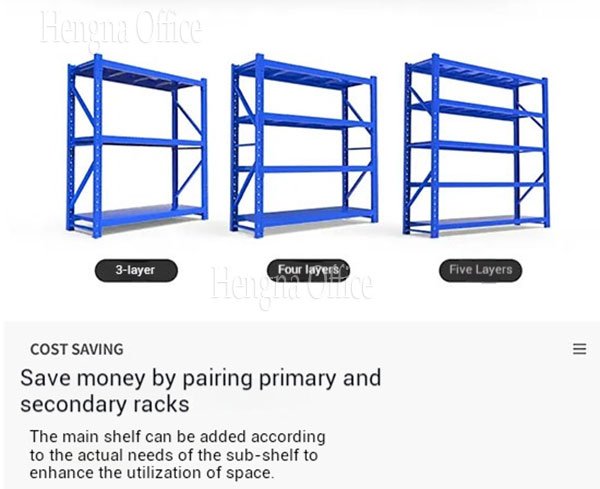
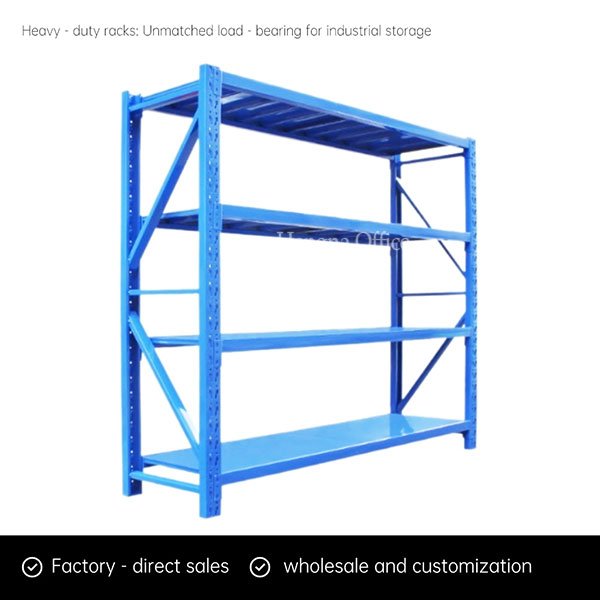
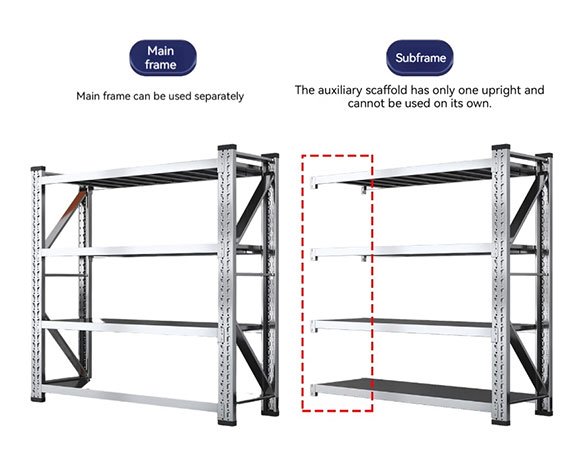
The key structural advantage is the main+subframe design. Start with one bay. When more capacity is needed, add subframes instead of buying complete new racks. A subframe uses one upright instead of two, sharing the adjacent main frame’s upright. One main frame supports multiple subframes in a row.
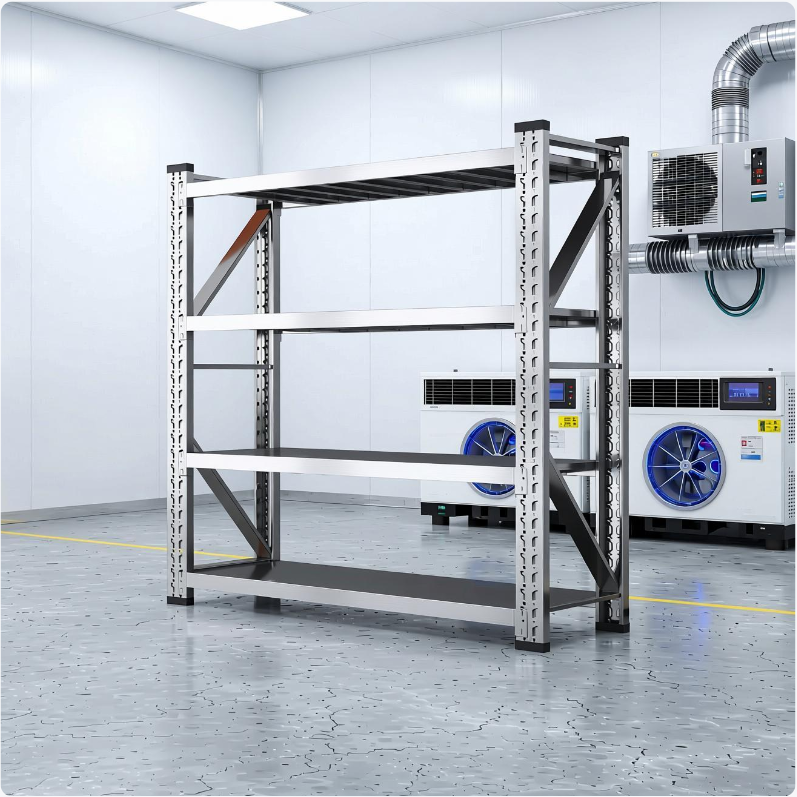
304 Stainless Steel Shelving for Cold Storage Rooms Specifications
| Item | Value |
|---|---|
| Material | 304 Stainless Steel (standard, cold storage grade) |
| Alternate Material | 201 Stainless Steel (dry cold storage only) |
| Surface Finish | Bare stainless, uncoated |
| Tiers | 4 (standard), 3 or 5 available |
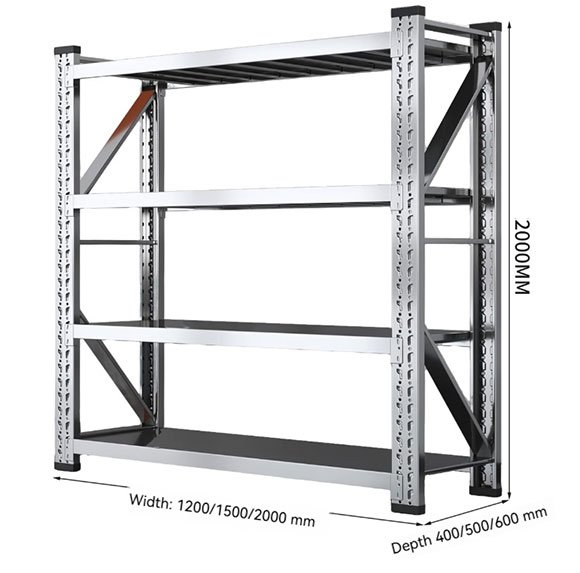
| Height | 2000mm |
| Width | 1200 / 1500 / 1800 / 2000mm |
| Depth | 400 / 500 / 600mm |
| Load Rating | Per shelf — three options, medium to heavy duty |
| Structure | Main frame + subframe modular, expandable in-line |
| Assembly | Butterfly snap connectors, no tools |
| Packaging | KD knock-down, moisture film + corner protectors |
| Lead Time | 7–15 days (standard), 15–30 days (custom orders) |
| MOQ | 1 unit (sample orders accepted) |
| Certification | CE certified |
Key Features
304 Stainless Steel — Corrosion Resistance That Doesn’t Depend on a Coating.
Cold storage condensation is relentless. Every time the door opens, warm moist air hits cold metal surfaces and condenses. Painted or powder-coated racks develop pinhole rust where the coating is thin, then rust spreads along weld lines and cut edges. 304 stainless steel has no coating to fail. The corrosion-resistant layer is the material itself. Scratches, dings, and abrasions don’t expose anything underneath.
Expandable Without Buying Duplicate Frames.
Cold storage is often built in phases — start with one section, expand as volume grows. The main+subframe system supports this approach. Buy one main frame and a few subframes to start. When more shelf space is needed, add subframes to the existing row. Each subframe saves one upright’s worth of steel cost compared to a standalone unit. The longer the row, the more savings per bay.
Reinforced Shelves for Frozen Loads.
Frozen food cases weigh 18–25 kg each. A single shelf may carry 40–60 cases. Thin sheet-metal shelves bow under this load within a year, creating unstable stacking surfaces. This unit’s shelves have welded reinforcement ribs underneath. The ribs distribute weight across the frame and prevent mid-span sagging over time.
Tool-Free Assembly Saves Cold Room Time.
Working inside a cold room is uncomfortable and expensive — every minute the door is open, temperature rises. The butterfly snap assembly requires no wrenches, no screwdrivers, and no power tools. Two people can assemble five or six units in half an hour, start to finish. Disassembly for relocation is equally fast.
201 vs 304 in Cold Storage — A Practical Guide
This is the most common question in cold storage shelving purchases. The answer depends on what kind of cold room.
- 304 stainless steel — the correct choice for most cold storage. Handles condensation, washdowns, and high-humidity environments without corroding. Recommended for frozen food storage, fresh produce cold rooms, meat and seafood processing areas, and pharmaceutical cold storage.
- 201 stainless steel — a lower-cost option that works in dry cold storage (frozen dry goods, packaging materials, low-traffic freezers). Not recommended for rooms where condensation is frequent, floors are washed regularly, or humidity stays above 85%.
The short version: for wet cold storage, 304. For dry freezers, 201 is a possibility — but verify the environment first. If unsure, describe the room conditions and we will recommend the right grade.
Typical Applications
Frozen food cold rooms — frozen meat, seafood, vegetables. 304 handles condensation without staining or pitting. Reinforced shelves support stacked cases.
Fresh produce cold storage — fruits and vegetables. High humidity and regular washdown cycles. 304 does not corrode under these conditions.
Pharmaceutical cold storage — GSP compliance requires materials that do not rust or shed particles. 304 with an easy-clean surface passes inspection requirements.
Dairy and ice cream freezers — -18°C to -25°C. Ordinary steel racks frost up and corrode within months. 304 maintains surface integrity.
Ultra-low temperature freezers (-30°C and below) — 304 stainless steel retains toughness at low temperatures better than carbon steel, which becomes brittle. Custom configurations available.
Packaging & Assembly
Shipped KD (knock-down). Uprights, shelves, and beams are packed in separate bundles. Each layer is wrapped in moisture-resistant film first, then bubble film, with corner protectors to prevent edge damage during sea freight. Compact packaging keeps shipping volume manageable.
No tools are needed for assembly. Two people set up five or six bays in half an hour. Reconfiguration or relocation is just as fast — the snap connectors release with a push.
Customization
Cold storage rooms come in non-standard dimensions. Standard width, depth, and tier options cover most layouts. For the rest — custom height, reinforced shelf ratings, modified post spacing — OEM runs are available through Luoyang Hengna Office Furniture Co., Ltd. Logo printing, branded packaging, and custom manuals are included in the service.
Contact us with requirements. A quotation is returned within 24 hours.
FAQ
Q: Can 201 stainless steel be used in cold storage?
A: In dry cold rooms — frozen dry goods, low-traffic freezers — 201 is acceptable. For wet cold storage with condensation or washdowns, 304 is recommended.
Q: How do I determine the right size?
A: Measure the available floor depth, account for aisle width, then calculate the number of bays and tiers needed. If unsure, send the room dimensions and we will lay it out.
Q: What is the steel thickness?
A: Thickness varies by load rating. Contact us with your load requirements for accurate specifications.
Q: What is the warranty?
A: One year. Non-human damage is covered with replacement parts.
Q: How fast can I get a quote?
A: Within 24 hours. Send cold room conditions, product type, bay count, and material preference.
Q: What shipping terms are available?
A: FOB or CIF, depending on destination port and order size.
Get a Quote
Review the specifications above, then contact us with your requirements — cold room temperature, product stored, washdown frequency, and quantity needed. A quotation is returned within 24 hours. Contact details are on the website.