Every church secretary who has stared at a pile of index cards on Monday morning has asked the same question: how many of these will actually fit in a card catalog drawer? Buy too few drawers and you are stacking cards sideways on top. Buy too many and you have paid for cabinet space you never use.
The honest answer is not a single number. It depends on the card size, the drawer depth, and how thick your card stock is. But once you run the math once, you will never have to guess again. Here is how it works for a typical steel card catalog cabinet.
Start with the Card Size, Not the Cabinet
Church record cards come in a few standard sizes. The most common by far is 3 x 5 inches (76 x 127 mm) – the index card you use for baptismal records, membership rolls, and funeral home notifications. A smaller share of churches use 4 x 6 inches (102 x 152 mm) for parishioner files that need more room for notes.
Before you look at any cabinet, measure the cards you actually have. A card catalog drawer built for 3 x 5 cards will swallow 4 x 6 cards sideways. A drawer built for 4 x 6 cards leaves wasted air around 3 x 5 cards.
| Card Size | Dimensions (mm) | Typical Church Use |
|---|---|---|
| 3 x 5 in | 76 x 127 | Baptismal records, membership rolls, contact cards |
| 4 x 6 in | 102 x 152 | Parishioner history, wedding records with notes |
| 5 x 8 in | 127 x 203 | Church history archives, large-format registry cards |
The Capacity Formula
A single index card on 67 lb cover stock is roughly 0.23 mm thick. On lighter 90 gsm card stock, it is closer to 0.18 mm. Add paper divider tabs and a few plastic guide cards, and you lose about 10% of the usable drawer height.
The math is straightforward:
Usable card capacity = (drawer internal height x 0.9) / card thickness
For a standard card catalog drawer with roughly 35 mm of internal vertical clearance, on 67 lb cover stock:
35 mm x 0.9 / 0.23 mm ~ 137 cards per drawer
On lighter 90 gsm stock, the same drawer holds closer to 175 cards. Add divider tabs every 25 cards and that drops to around 120 cards per drawer.
Real-World Drawer Capacity Table
Steel card catalog cabinets ship in 2, 3, or 4 drawer heights. Here is what you can actually expect from each, using standard 3 x 5 cards on 67 lb cover stock with divider tabs:
| Cabinet | Drawers | Cards per Drawer | Total Capacity | Best For |
|---|---|---|---|---|
| 2-drawer unit | 2 | ~120 | ~240 cards | Small parish (under 100 members) |
| 3-drawer unit | 3 | ~120 | ~360 cards | Mid-size congregation, parish offices |
| 4-drawer unit | 4 | ~120 | ~480 cards | Large church, archive room |
These are working numbers, not marketing claims. A church running a 150-year-old membership roll will hit the 4-drawer limit inside five years. Plan for 20% growth on top of your current card count – not 10%. Churches accumulate funerals, baptisms, and new members faster than anyone expects.

Why Drawer Depth Matters as Much as Drawer Height
Most people size a card catalog cabinet by height and drawer count. They forget the drawer depth. A card catalog drawer that is too deep means cards slide to the back where no one can reach them without dumping the whole drawer out.
For 3 x 5 cards, an internal drawer depth of around 280-320 mm is the sweet spot. That gives you one layer of cards lying flat, side by side, with your fingers reaching the back row. Deeper than that and you start double-stacking – which is exactly how cards get bent, misfiled, and lost.
For 4 x 6 cards, bump the internal depth to 350-380 mm. Anything shorter and the cards stick out past the drawer lip.
Church-Specific Considerations
Church records are not office filing. A few things change the math:
Divider tabs are non-negotiable. You will be sorting by last name, by sacrament type, or by decade. Plan on one divider tab every 25 cards. That costs you about 10% of capacity, which is already built into the table above.
Some cards get copied, not stored. Baptismal and marriage records that have been microfilmed or scanned do not need to live in the card catalog. Keep the originals in a fireproof drawer and move the duplicates to a secondary cabinet. Most churches we have talked to over-store because they cannot bring themselves to throw anything away – scanning solves that.
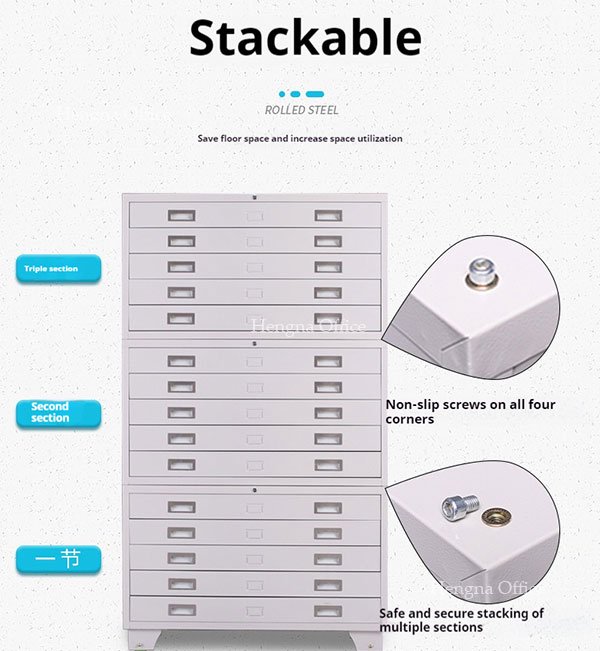
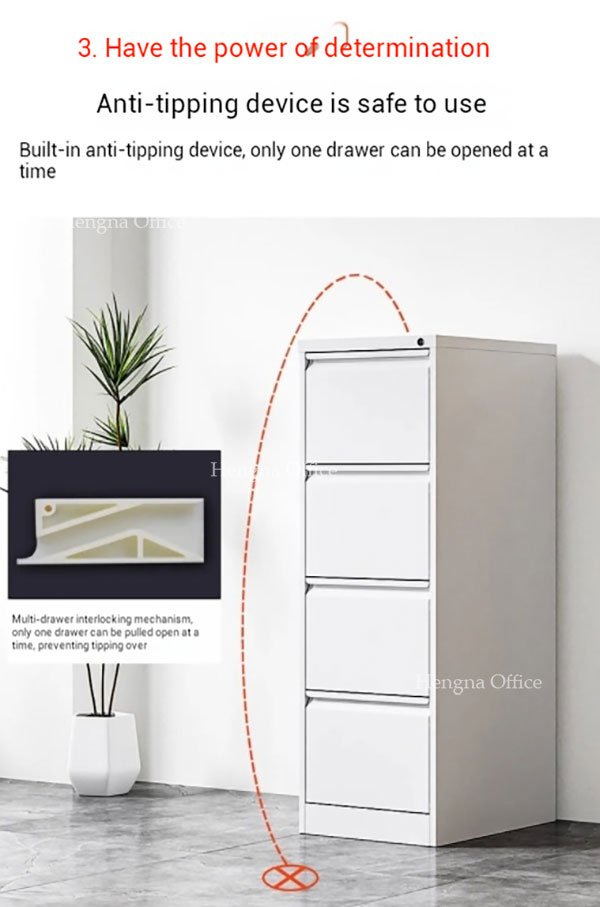
Anti-tipping hardware is worth the upgrade. A card catalog cabinet full of cards is heavy on top. Built-in interlock hardware (only one drawer opens at a time) prevents the whole unit from tipping forward when a volunteer yanks the top drawer without thinking. This matters more in a parish office where volunteers come and go and no one reads the warning label.
Worked Example: Sizing for a Mid-Size Parish
Say your church currently holds 280 active member cards on file, plus about 60 historical baptismal cards kept for archive. That is 340 cards today. Add 20% growth and you are planning for 408 cards over the next five years.
At 120 cards per drawer, you need 408 / 120 ~ 3.4 drawers, rounded up to 4. A 4-drawer unit covers you with one drawer to spare. Skip the 2-drawer unit – it fills in under two years. Skip the doubled 6-drawer stack unless you already scan half your records, because you are paying for empty drawer space you will not use this decade.
This math assumes 3 x 5 cards on standard cover stock. If your parish runs on 4 x 6 cards, drop the per-drawer count to 90 and rerun the division.
FAQ
How many 3 x 5 cards fit in one drawer on average?
About 120 cards on 67 lb cover stock with divider tabs. On lighter card stock, closer to 175. The exact number depends on how thick your cards are and how many plastic guide tabs you use.
Can I store 4 x 6 cards in a 3 x 5 drawer?
You can physically, but you should not. The cards overhang the drawer front, the label holder does not close, and you will eventually crease the corner of every card. Size the drawer to the larger card format and mix smaller cards freely.
Do card catalog cabinets ship flat-pack?
Yes, most steel card catalog cabinets ship knocked-down to save freight. Two people can assemble a 3-drawer unit in under 30 minutes. The drawers slide on ball-bearing rails and drop into the cabinet shell.
What is the difference between a card catalog and a filing cabinet?
A filing cabinet stores hanging folders and full sheets of paper. A card catalog has shallow, narrow drawers built specifically for index cards. The drawer dimensions are different, the rail spacing is different, and you cannot substitute one for the other without losing space.
Bottom Line
Count your current cards, add 20% growth, divide by 120 per drawer – that is how many drawers you need. Pick a cabinet whose internal depth matches your card size, insist on anti-tip interlock hardware, and do not overbuy the 4-drawer unit if a 3-drawer already covers your projected growth. Your parish secretary will thank you the next time they have to pull a baptismal record on short notice.