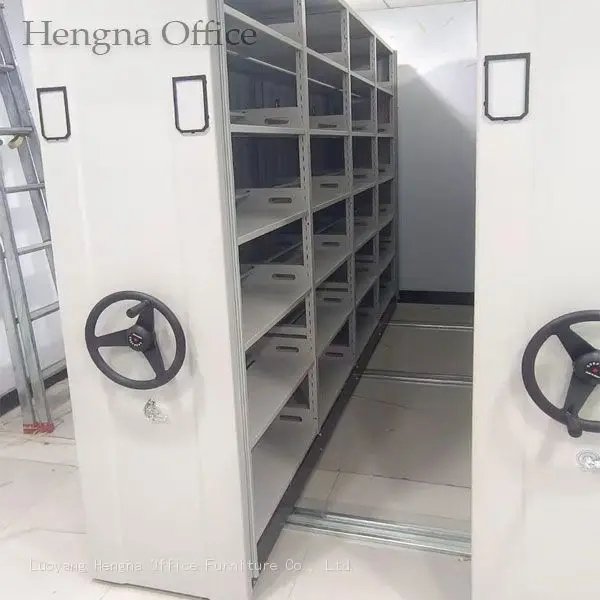
If you have ever pulled a rolled drawing out of a tube, unrolled it on a conference table, and watched the edges curl back into a tube the second you let go, you already know why flat file cabinets exist. Rolled drawings crease at the tube ends, the ink cracks on fold lines, and archivists eventually stop trusting anything stored that way. The fix is simple: store sheets flat, in drawers sized exactly for the paper.
The hard part is picking the right drawer depth. Buy one too shallow and your A1 sheets overhang; buy one too deep and you waste floor space you did not have to waste. This guide walks through the standard sheet sizes, the drawer sizes that actually fit them, and the mistakes that show up six months after delivery.
Standard Drawing Sizes – The Numbers You Need
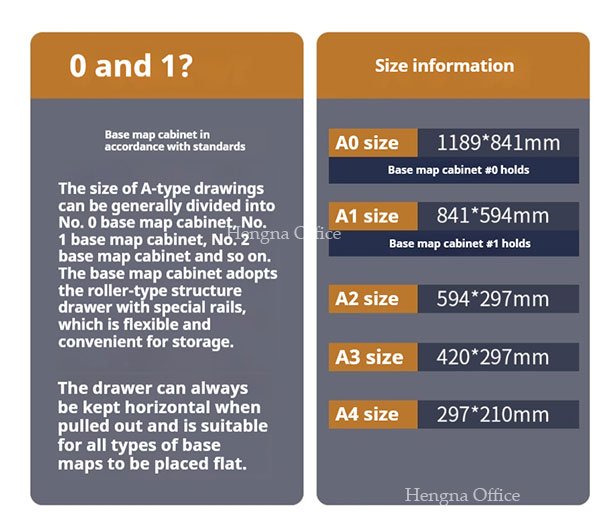
Architectural and engineering sheets follow the ISO A-series. Every size halves in area when you fold it once, which is why the dimensions keep halving too. Here is what they actually measure:
| Sheet Size | Dimensions (mm) | Dimensions (inches) | Typical Use |
|---|---|---|---|
| A0 | 1189 x 841 | 46.8 x 33.1 | Full construction drawings, master plans |
| A1 | 841 x 594 | 33.1 x 23.4 | General arrangement drawings, site plans |
| A2 | 594 x 420 | 23.4 x 16.5 | Detail sheets, construction details |
| A3 | 420 x 297 | 16.5 x 11.7 | Shop drawings, close-up details |
| A4 | 297 x 210 | 11.7 x 8.3 | Reports, specifications, small sketches |
North American shops also run on ANSI sizes (ARCH-A through ARCH-E), which run a little larger in one direction than their ISO equivalents. If your firm mixes both systems, size your drawers to the largest sheet you actually keep on shelves, not the largest one you have ever seen.
Why Drawer Depth Is the Spec Nobody Checks
When people shop for a flat file cabinet, they compare width, height, and price. They rarely measure the inside of the drawer. Then the cabinet arrives and the A1 sheets sit proud of the front lip by 15 millimeters. The label holder no longer closes. The next person who yanks the drawer cracks a corner.
A drawer that holds a sheet flat needs roughly 25-50 millimeters of clearance on each side of the paper. That gap is not waste – it is what lets you slide sheets in and out without catching the edge on a roller rail. Tight drawers jam. Over-sized drawers waste vertical space because each drawer is taller than the paper stack inside it.
Two practical rules:
- Drawer inside dimension should be at least 25 mm wider and deeper than your largest sheet. No exceptions. This is the difference between a drawer that glides and one that binds.
- Match the drawer series to the sheet size, not the other way around. A “No. 0” cabinet is built for A0. A “No. 1” cabinet is built for A1. Mixing sheets inside one drawer works, but mixing drawer series does not – a No. 1 drawer is too short to hold A0 without folding.
Which Cabinet Series Fits Which Sheet Size?
Most steel flat file cabinets ship in numbered series, and the number tells you exactly what paper it holds:
| Cabinet Series | Fits Sheet Size | Drawer Inside (approx.) | Best For |
|---|---|---|---|
| No. 0 | A0 (1189 x 841 mm) | ~1250 x 890 mm | Architecture firms, city planning, master plans |
| No. 1 | A1 (841 x 594 mm) | ~900 x 640 mm | Engineering consultants, structural shops |
| No. 2 | A2 (594 x 420 mm) | ~650 x 470 mm | Interior designers, detail drawings |
| No. 3 | A3 (420 x 297 mm) | ~470 x 340 mm | Small shops, shop drawings, archives |
The inside dimensions above are typical industry values – always confirm with the supplier’s cut sheet before you order, because tolerances vary by 10-20 mm between factories.
Stackable Sections – When One Cabinet Is Not Enough
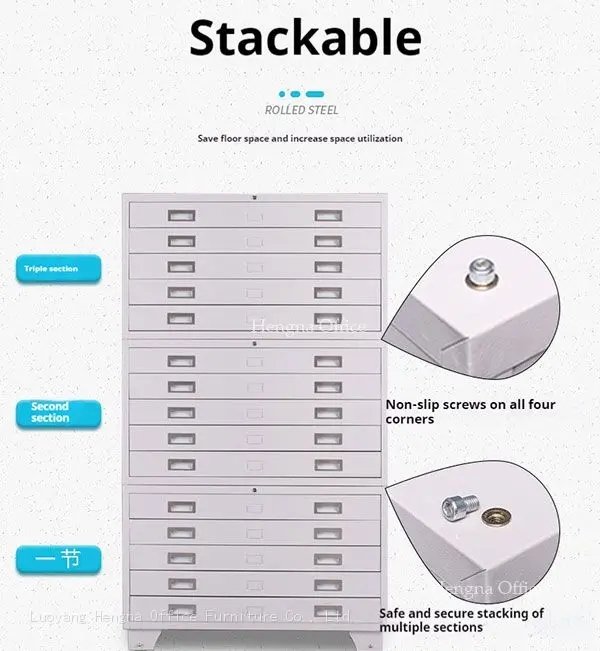
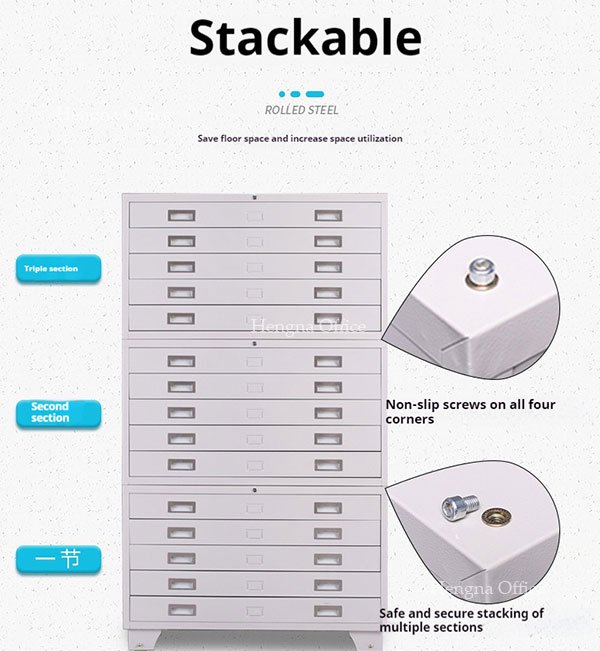
Flat file cabinets are short and wide. A single section is usually 10 drawers tall and sits around the waist. Once you fill that, you have two choices: buy a second freestanding cabinet, or stack a second section on top of the first.
Stacking saves floor space because the footprint stays the same. But it only works if the cabinet has the right hardware. Look for non-slip positioning screws on the top corners of every section – these lock the upper section to the lower one so it does not slide when someone pulls a drawer. Without them, a stacked cabinet becomes a tipping hazard.
Most shops run three-high stacks: base section, middle section, top section. Anything taller than that becomes awkward to load, and you need a step stool every time you need a sheet on top.
Sizing Mistakes That Cost Real Money
After helping spec these cabinets for offices, I have seen the same mistakes repeat:
Mistake 1: Buying a No. 1 cabinet “because A0 is overkill.” Six months later, the firm wins a municipal project and suddenly needs A0 storage. Now the A0 sheets roll up in tubes anyway, defeating the point of the flat files.
Mistake 2: Measuring the outside of the drawer instead of the inside. The outer drawer front looks wide enough. The actual paper space is 40 mm narrower. Measure inside the drawer box, not the face.
Mistake 3: Forgetting the label holder. Every drawer needs a label slot on the front. If the drawer is 25 mm too deep, the label holder stays open and collects dust.
Mistake 4: Skipping the anti-slip screws when stacking. The cheapest upgrade in the whole purchase, and the one people skip. It is also the one that prevents a cabinet from walking off its base.
FAQ
Can I store A1 sheets in a No. 0 cabinet drawer?
Yes. A No. 0 drawer holds A0, so A1 sheets fit with room to spare. Just know you are paying for drawer space you do not fully use. Most firms mix sizes in No. 0 drawers anyway.
Do flat file cabinets ship assembled?
Most steel flat file cabinets ship knocked-down (flat-pack) to save freight. Drawer fronts and rails slide into slots. Budget about 30-45 minutes per section for two people.
How many sheets fit in one drawer?
A typical No. 1 drawer holds roughly 300-500 A1 sheets depending on paper weight. At 80 gsm bond, you get closer to 500; at thicker plotter stock, closer to 300. If you store Mylar or sepia prints, cut that number in half.
What is the difference between a flat file cabinet and a blueprint cabinet?
Same thing. “Flat file” is the standard term in North America; “blueprint cabinet” or “base map cabinet” shows up in UK, Australian, and Asian supplier listings. They all describe horizontal drawers that hold large-format sheets flat.
The Bottom Line
Pick the cabinet series by your largest regularly stored sheet, leave 25 mm clearance inside the drawer, and confirm the inside measurement on the cut sheet before you place the order. Do that and your drawings stay flat, your drawers glide, and nobody has to roll an A1 onto a conference table ever again.
Need help matching a cabinet series to your sheet sizes? Send us your largest format and how many sheets per year you archive – we will spec the right drawer count and section height.