A bank records room is usually full and always being audited. The card indexes — loan files, account reference cards, customer history cards — keep growing, and the question that comes up every quarter is not “should we buy more cabinets” but “how many drawers do we actually need.” Buy too few and the cards spill into temporary boxes. Buy too many and you have paid for empty drawers and floor space the branch does not have. The job is to match card file cabinet drawers to the volume you hold. We build these from the factory floor, and here is the spec-check we run with buyers.
Start from the number you already know
Every drawer in our cabinet holds roughly 200 folders or index cards. That one number does most of the sizing work:
- 2 drawers × 200 = about 400 card groups per cabinet
- 3 drawers × 200 = about 600 card groups per cabinet
- 4 drawers × 200 = about 800 card groups per cabinet
Count the card boxes on the shelf, divide by 200, and you have the drawer total. Then split that total across cabinets by floor space: one 4-drawer unit, or two 2-drawer units, the math lands in the same place.
The 2 drawer, 3 drawer, and 4 drawer sizes
The narrow vertical line is the default for high-density card storage. It is 460 mm wide and 620 mm deep — slim enough to run rows down a records corridor without eating the aisle.
| Drawers | Height (mm) | Footprint | Holds about |
|---|---|---|---|
| 2-drawer | H720 / 730 | W460 × D620 mm | 400 cards |
| 3-drawer | H1020 / 1030 | W460 × D620 mm | 600 cards |
| 4-drawer | H1320 / 1330 | W460 × D620 mm | 800 cards |
| 5-drawer (step-up) | H1631 | W460 × D620 mm | 1000 cards |
The wide lateral line is for rooms that also hold hanging files or larger folders. It runs 900 mm deep and 450/460 mm wide.
| Drawers | Height (mm) | Footprint |
|---|---|---|
| 2-drawer | H730 | W450/460 × D900 mm |
| 3-drawer | H1030 | W450/460 × D900 mm |
| 4-drawer | H1330 / 1331 | W450 × D900 mm |
Dimensions carry a ±10 mm factory tolerance; confirm against the physical drawing in the quotation.
How to choose between 2, 3, and 4 drawers
Choose the 2-drawer unit when the card group is small or the room is tight — under a window, beside a vault entrance, or at a branch with no long wall. At 720–730 mm tall it is the lightest to move and the easiest to reach.
Choose the 3-drawer unit when you want one cabinet per record series, and the top drawer stays reachable standing. About 1030 mm tall, no step stool needed.
Choose the 4-drawer unit when the records room is the central store and staff pull cards all day. At 1320–1330 mm tall, four drawers per cabinet means fewer cabinets along the wall, which means more aisle — and the top drawer is still a normal reach.
If a room outgrows the 4-drawer line, the 5-drawer narrow unit at H1631 exists as the next step up before you start a second row.
What every drawer count has in common
Whatever drawer number you land on, the build underneath it is the same:
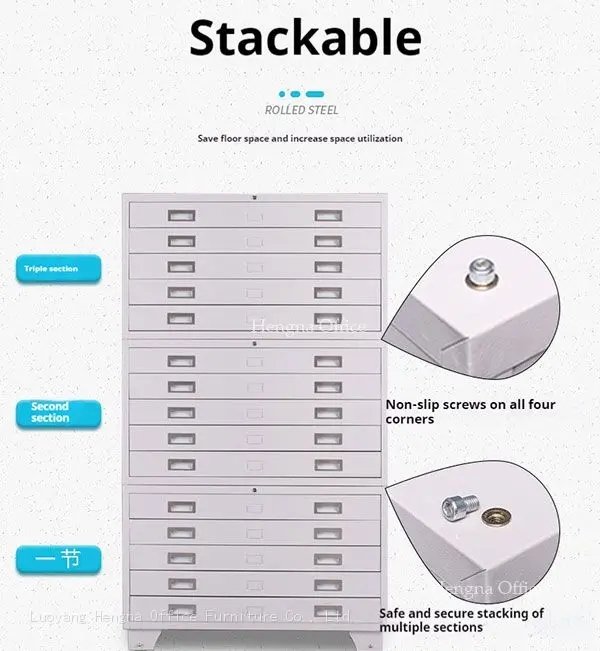
- Cold-rolled steel sheet, 0.6–0.8 mm thick, electrostatic powder coat — rust-resistant in a basement records room
- 3-section ball bearing slides, full extension, around 35 kg load per drawer
- Central locking with a steel core; same-batch keys do not cross-open between cabinets
- Anti-tip interlock — only one drawer opens at a time, so a loaded row never tips
- Label holders on each drawer face, and a follower block to keep cards upright
- KD flat pack, which saves sea freight on a full-container order
For a bank, the non-cross-opening lock and the anti-tip interlock are the two points auditors care about: cards stay confidential, and staff stay safe.
How the rows sit in a records room
Once the drawer count is settled, the layout decides how dense the room really gets. Run the narrow 620 mm units in straight rows along the wall, backs to the wall, fronts facing a clear aisle. Because each cabinet is only 460 mm wide, a row packs more card storage per metre of wall than deep lateral cabinets, and the aisle stays wide enough for a records clerk with a box.
Put the busiest drawers at mid height — the middle drawers of a 3- or 4-drawer unit — so daily card pulls do not become bending or stretching exercises. Reserve the top drawer for series that are asked for once a month, and keep the heaviest, least-used cards low. In a bank room where the audit walk is a straight line down that aisle, the cabinet row reads as one tidy, labelled, locked wall.
FAQ
How many index cards fit one drawer? Around 200 folders or cards per drawer. Multiply by the drawer count for the cabinet total.
Which size fits a tight records corridor? The narrow 620 mm depth line. A 4-drawer narrow unit stores about 800 cards in a 460 × 620 mm footprint.
Do keys open more than one cabinet? No. Lock cores are grouped per batch, so a key opens only its own cabinet.
Can I mix 2, 3, and 4 drawer units in one order? Yes. Mix drawer counts and colours on the same order — white, grey, or two-tone — and confirm the mix in the quotation.
What is the delivery time? Standard models ship in 20–30 days. A custom mix or logo depends on quantity.
Where do I get a spec sheet and price? Send us your card count, the drawer mix you are leaning toward, and the delivery port — FOB or CIF from Qingdao or Tianjin — and the quote goes out within 24 hours.
A final buying note
Matching card file cabinet 2 drawer 4 drawer sizes to your card volume is a 200-cards-per-drawer calculation away. Get the count right, put the cabinets in 620 mm narrow rows, and the records room stops being a box room. That is the whole job of bank high density index card storage: the cards stay dense, sorted, locked, and auditable.
Cindy Steel Furniture — factory-direct steel card file cabinets, built for bank high density index card storage.