If you run an exam center, you know the drill. Candidates walk in with phones in their pockets, and once the papers come out, that phone is the one thing that can ruin a session. A smartwatch buzzes under a sleeve, a device gets passed down a row, or half the room visibly checks something the moment you call time. Then there is what happens to all those devices once you collect them: a plastic bin on a desk, a drawer with a broken lock, a pile on the front counter. Phones get mixed up, batteries die by pickup time, and at the end of a long day you hand the wrong device to the wrong person. A cell phone charging locker built for exam centers is the fix we build at the factory — locked custody with charging, so devices leave the exam room and come back charged and claimed.
What the phone problem looks like on exam day
Walk through a normal morning at a test center and the phone problem shows up three times.
First, the room. Any device left in a candidate’s hand is a cheating risk and a distraction. You can announce a no-phone rule, but enforcement means walking the rows before every paper, and half the arguments of the day start with “it was on silent.”
Second, the custody. Someone has to hold forty or two hundred devices for three hours. A bin means nobody can prove which phone belongs to whom. One switched-off phone handed to the wrong candidate after the exam is a complaint you spend the next week sorting out.
Third, the return. Candidates come back tired and in a hurry. A dead phone is an angry candidate. A wrong phone is worse.
A phone charging locker with individual lock solves all three at once: each device goes into its own numbered compartment, locked and charging, with one proof per return. That is the whole job of exam center phone storage, and why test centers increasingly spec a proper locker instead of a box.
How the deposit-and-return flow works
Here is the routine in a center using our lockers.
Before the exam, candidates walk to the locker bank, open one compartment, slide the phone in, plug it in, and close the door. On the barcode model the cabinet prints a slip — barcode, code, compartment number; on the PIN model the candidate sets a six-digit password. Nobody else can open that compartment.
During the exam, devices sit locked and charging, and staff can see on the LCD which compartments are occupied or empty. An early-leaving candidate is cleared by an admin through the management key or control panel.
After the exam, the candidate returns, scans the slip or types the code, and their own compartment pops open. They take the phone — battery topped up — and the compartment is ready for the next session.
One compartment per device, one proof per return — custody, not a warehouse process.
Picking the door count for your center
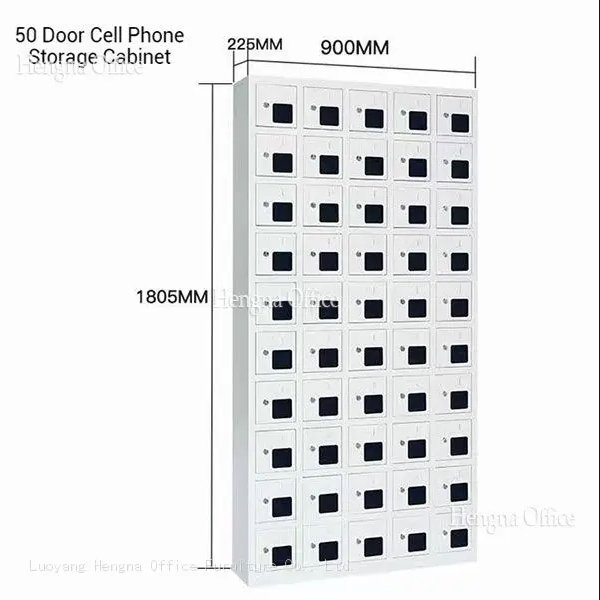
We build these in 12, 18, 24, 36, and 48 compartments, and the count follows your daily peak, not your average.
| Layout | Size (H × W × D, mm) | Footprint |
|---|---|---|
| 12-door | 1800 × 850 × 460 | One wall run, small hall or single classroom |
| 24-door | 1800 × 1700 × 460 | Standard exam room block |
| 36-door | 1800 × 2550 × 460 | Large test center |
| 48-door | Custom width, 460 deep | Peak exam days, add-on banks |
Each single compartment is about 270 mm high and 300–460 mm wide and deep — a phone slides in easily, and so do a small bag, a pencil case, or a handheld device you also need out of the room.
The sizing rule: count your busiest weekly session, then add twenty percent. A 24-door cabinet covers most single-room halls; centers running two rooms start with a 24-door master and add sub-cabinets on the same system — one built-in computer runs the master plus any number of linked sub-cabinets.
Which unlocking mode fits an exam center
We offer six opening modes, and they can be mixed within one system: infrared barcode with a thermal printer, IC card swipe, face recognition, fingerprint, a self-set six-digit PIN, and coin-operated.
For an exam center, the barcode or self-set PIN model is the default, and here is why:
One-time proof. A printed barcode slip cannot be copied or lent, and it is used once. A six-digit code set by the candidate clears automatically after the door opens. No cards to issue, no cards to collect back.
No accounts to manage. Students and candidates do not need a card, an app, or an enrollment. They walk up, open a compartment, and leave with a slip.
Admin override stays simple. Staff hold the mechanical emergency key, and a voice prompt plus LCD screen walk first-time users through the steps. Selected models keep compartment memory through a power cut, and the mechanical key opens what the electronics cannot.
If your center also runs staff access, mixing modes costs nothing extra: master barcodes for candidates, side cabinet IC cards for staff, one management panel.
The charging part, in plain terms
A locker that only stores phones is half the job. Ours carries Type-C charging in each compartment, with overload protection, short-circuit protection, and leakage protection built into the control board, wired with copper cabling behind the steel doors. The cabinet body is cold-rolled steel, phosphated and finished in an environmentally friendly powder coat, so the whole bank stands up to thousands of open-and-close cycles a year.
The cabinet ships fully assembled. It lands at your center, you plug it in, and it starts working — no installation crew, no weekend of bolting panels. The charging spec sheet and your market’s configuration are confirmed in the quotation; tell us your country’s power standard and we quote the matching build.
Spec sheet
Here is the cabinet we build, in plain numbers, so you can compare it against any quote:
| Specification | Value |
|---|---|
| Compartments | 12 / 18 / 24 / 36 / 48, custom counts available |
| Sizes | 12-door 1800×850×460; 24-door 1800×1700×460; 36-door 1800×2550×460; 48-door custom |
| Single compartment | approx. 270 mm H × 300–460 mm W/D |
| Body | Cold-rolled steel, phosphated, powder coat |
| Opening modes | Barcode, IC card, face, fingerprint, PIN, coin — mixable in one system |
| Controls | LCD screen, numeric keypad, voice prompt, barcode scanner, thermal printer (barcode model) |
| Emergency | Mechanical master key; power-loss memory on selected models |
| Expansion | Master cabinet + linked sub-cabinets |
| Charging | Type-C per compartment; overload, short, leakage protection; copper wiring |
| Delivery | Fully assembled, plug and use |
| MOQ | 1 unit; sea freight cost-effective from 5 units |
| Lead time | Standard 7–15 days; custom 15–25 days |
| Warranty | 1 year whole unit; control board and electronic locks replaced free in year one |
| Certification | CE |
FAQ
Can candidates open their own compartment without an admin? Yes. Barcode model: the cabinet prints a slip with barcode, code, and compartment number. PIN model: a six-digit code the candidate sets, cleared after use.
What if the power goes out mid-exam? Selected models remember compartment states through a power cut, and staff always hold the mechanical emergency key.
Do we have to issue cards to every candidate? No. For exam flow, barcode or PIN is standard — no cards issued, none collected.
Can we mix candidate access with staff access? Yes — master barcodes for candidates, sub-cabinet IC cards for staff, one control system.
How many compartments should a center start with? Count your busiest session and add twenty percent. Most single halls start at 24 doors; larger centers add sub-cabinets later.
What does it cost, and how fast can it ship? We do not post prices online. Standard cabinets ship in 7–15 days, custom in 15–25 days — send the door count and your port, and the quote goes out within 24 hours.
A final buying note
For an exam center, the phone rule only works if custody is instant and provable. A locked compartment per device, a one-time proof per return, charging waiting inside, and a cabinet that plugs in and goes to work — that is what takes the phone problem off your desk and out of the exam room. Set it up once, and on exam morning the only thing you think about is the papers.
Cindy Steel Furniture — factory-direct phone charging lockers, built for exam centers.