Factory EHS managers who have rolled out a “phones away on the line” rule eventually hit the same fork: do you lock every worker’s phone in a charging locker, or do you hand out fabric charging pouches at the door?
Both options stop phones from ending up on the production line. They cost different amounts, break in different ways, and annoy workers in different ways. This guide breaks down the real differences so procurement can pick the right one before wasting budget on the wrong system.
What Is a Charging Pouch?
A charging pouch is a fabric or neoprene sleeve with a USB cable running inside. The worker zips their phone into the pouch at the entrance, plugs it in, and drops the pouch on a shelf or hangs it on a hook. No lock, no individual door, no compartment.
You will see these in high-security offices, server rooms, and some pharmaceutical cleanrooms. The pouch itself is cheap, and the whole system scales by buying more sleeves and more USB hubs.
The catch: there is no individual access control. Anyone can unzip any pouch while you are not looking. The phone charges, but it is not actually secured. For factories that need a real chain-of-custody trail for personal devices, pouches are a weak answer.
What Is a Phone Charging Locker?
A phone charging locker is a steel cabinet with individual locked compartments. Each compartment has its own USB port or USB-C outlet. The worker drops their phone in, closes the door, turns the key, and walks away. At break time, they unlock only their own compartment.
You usually see 12-door, 24-door, or 50-door configurations. Each compartment is roughly 250 x 250 mm, which fits most smartphones plus a thin case. Some units ship with a master key that the supervisor keeps for emergency access.

Side-by-Side Comparison
| Factor | Charging Pouch | Phone Charging Locker |
|---|---|---|
| Individual lock | No | Yes, one per door |
| Charging per device | USB hub shared | Dedicated port per compartment |
| Capacity per unit | Unlimited (add more sleeves) | Fixed (12/24/50 doors) |
| Workers per cabinet | 20 to 100+ on a shelf | One per door |
| Chain of custody | Weak (anyone can unzip) | Strong (key per person) |
| Physical security | Fabric sleeve only | Steel cabinet, lockable doors |
| Footprint | Shelf or wall hooks | Floor-standing unit |
| Best fit | Low-risk offices, server rooms | Factories, EHS-regulated plants |
When to Pick a Pouch
Pouches make sense when the goal is simply to keep phones off the desk, not to secure them. If you are running a small office, a server room, or a cleanroom where the rule is “no phones on shift” but nobody expects theft, a pouch system covers the requirement at a fraction of the cost of lockers.
Pouches also scale fast. Hire 50 new temps in a week? Buy 50 more sleeves. No installation, no floor space, no key management. The trade-off is that you give up individual accountability.
When to Pick a Charging Locker
Factories that handle proprietary tooling, client data on shift, or high-value equipment need more than a fabric sleeve. A phone charging locker gives you:
- Individual accountability. Worker A cannot open Worker B’s compartment. If a phone goes missing, you know exactly whose compartment it was in.
- Dedicated charging per door. No sharing a 10-port USB hub across 30 phones. Every door has its own port, so every device actually charges on a 12-hour shift.
- Audit trail. When the EHS inspector asks “where are worker phones during production?” you can point at a row of locked steel doors, not a shelf of unzipped pouches.
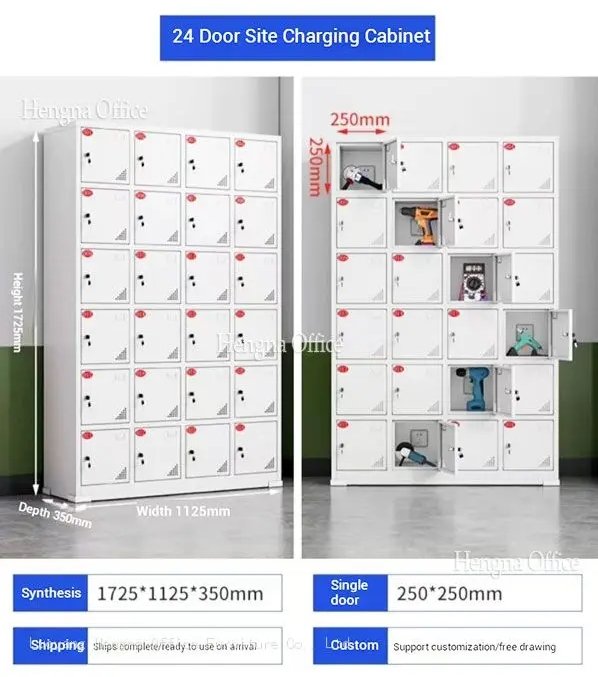
The 50-door configuration is the sweet spot for a mid-size production floor. It covers 50 workers in one footprint, and you can chain two units side by side for a 100-worker shift without doubling the floor space.
How a Typical Factory Floor Sets This Up
Most plants put the locker bank right at the change-room entrance, not down by the production line. Workers drop their phone in the compartment before they put on their uniform, which means the phone never makes it to the floor in the first place. This beats the alternative: a supervisor walking the line at 8 a.m. collecting phones into a cardboard box.
For a plant running two 12-hour shifts, one 50-door locker covers the morning crew. The afternoon crew uses the same compartments after morning crew picks up their phones at lunch. You do not need twice the doors, just a clear handover window.
Mount the unit on a non-slip base, bolt it to the wall if you are in an earthquake zone, and keep the master key in the EHS office. Workers lose keys all the time. The master key is the only thing standing between a lost shift and an unlocked cabinet sitting open for the afternoon.
Two Mistakes Procurement Makes
Mistake 1: Buying pouches “because they are cheaper” and then re-buying lockers six months later. If your plant runs on EHS audits or handles IP-sensitive work, you will end up at lockers anyway. Buy the locker first.
Mistake 2: Under-sizing the door count. A 12-door locker looks cheap. Then the night shift starts and you realize you need 30 doors. Plan for the largest shift you run, not the smallest. Most factories run 12 to 24 doors per shift per entrance.
FAQ
Can workers share a locker door?
No. Each door is one worker per shift. If you run two shifts, the morning worker unlocks, the evening worker uses the same compartment. But within one shift, one phone per door.
Do lockers need special wiring?
Most units plug into a standard 110V or 220V wall outlet. The USB ports run off an internal power supply. No electrician needed, just a grounded outlet within reach.
What happens if a worker loses their key?
The supervisor holds a master key that opens every compartment. This is standard on every steel phone locker we ship. Keep the master key in the EHS office, not taped to the cabinet.
Can I use a regular locker and add a power strip?
You can, but you create a cable mess inside each compartment. A purpose-built charging locker routes the cable cleanly behind the door so it does not get pinched or frayed.
Bottom Line
If you are running a factory floor where phones must be secured, not just stored, buy the charging locker. Pouches are fine for low-risk offices. The locker costs more upfront but survives the audit, the 12-hour shift, and the 50 workers who show up on Monday morning expecting a clean, locked place to leave their phone.