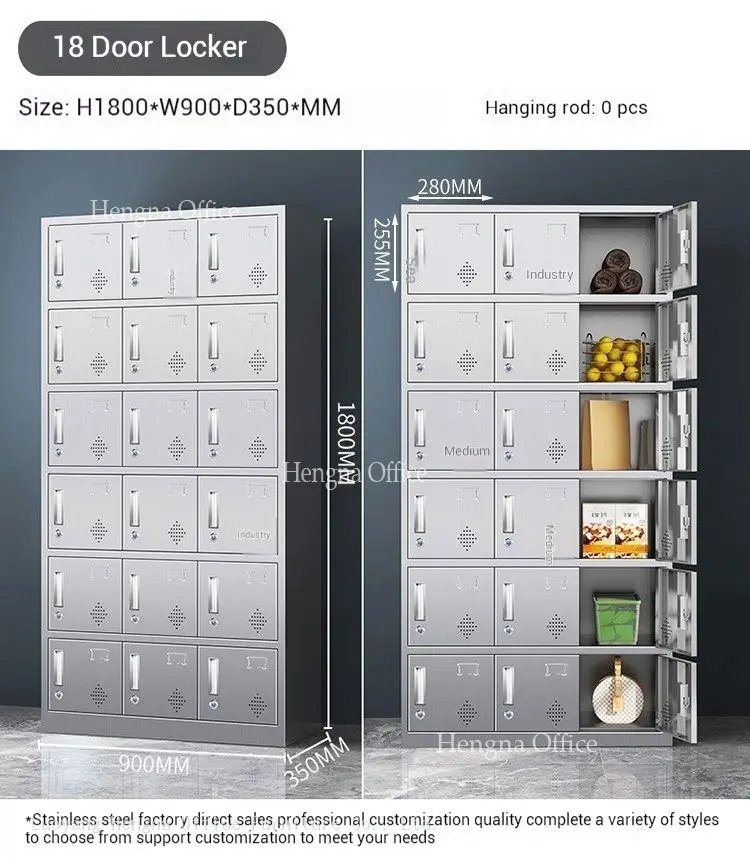
Here is a cost that hides in plain sight on almost every cabinet import: air. A fully assembled steel storage cabinet is a steel shell around a box of nothing. Ship ten of them and a large share of the container is empty space you paid to move across an ocean. The cabinets arrive fine. The freight invoice is the problem.
Flat pack metal storage cabinets attack that cost at the design stage. The cabinet ships as panels and hardware, stacked flat, and assembles into the same rigid unit on arrival — no screws, no special tools, no carpenter. For distributors and wholesale buyers, the knock-down design is not a compromise. It is the difference between a container that pays for itself and one that ships air.
Why Assembled Cabinets Waste Container Space
Freight is billed by volume as much as by weight, and an assembled cabinet is mostly volume. The doors, shelves, and panels inside a shipping container take up exactly the space they will occupy on the customer’s floor — plus the handling clearance around them. Load ten assembled cabinets into a container and much of what you are paying for is air between and inside them.
Knock-down design removes the air. The same cabinet ships as a stack of flat panels: sides, shelves, doors, back panel, and a hardware kit, packed tight in cartons. Panels nest. Cartons fill the container’s cross-section evenly. The same steel that becomes one bulky cabinet becomes a compact, dense stack of parts — and the container holds far more units before it is full.

How Knock-Down Design Actually Works
Knock-down sometimes gets a bad reputation from old flat-pack furniture that needed a weekend and a prayer. Modern steel cabinet knock-down is a different category — and the difference is the assembly method.
The current generation of knock-down steel cabinets uses a no-screw quick-assembly system: panels align into position and lock into each other with built-in fasteners, so assembly is a sequence of folding and locking rather than drilling and driving. No power tools, no loose screws to lose, no skill requirement beyond following the guide.
The design range covers the standard storage cabinet family: heights from roughly 390 mm to 1850 mm, widths of 900 or 970 mm, and depths of 400 or 500 mm — enough to cover everything from a low storage unit to a full-height cabinet. Finishes come in three standard schemes — light grey-white, coffee-white, and pure white — so a mixed order still reads as one product family.
The Freight Math Buyers Care About
Nobody buys knock-down cabinets for the joy of assembling them. The purchase decision comes down to landed cost, and this is where the numbers move.
| Cost Item | Assembled Cabinets | Knock-Down Cabinets |
|---|---|---|
| Units per container | Few — interiors and clearances eat space | Many more — panels pack flat and dense |
| Freight cost per cabinet | High — each unit carries its own air | Lower — freight divides across more units |
| Damage exposure | Assembled doors and frames take transit knocks | Flat panels are the most protected form steel can travel in |
| Warehouse handling | Bulky, forklift-dependent | Flat cartons, easier to receive and store |
Every buyer’s container math is different — cabinet sizes, destination port, and order volume all change it. The right move is to ask the factory to quote the same cabinet list both ways, assembled and knock-down, and compare the landed cost per unit. For most export orders, the knock-down quote wins by a margin that pays for the entire order’s packaging several times over.
Assembly on Arrival: What Your Customers Experience
The second question every distributor asks: what happens when the cabinet reaches the end customer? A knock-down cabinet that is miserable to assemble creates support tickets and refund requests.
Well-designed knock-down cabinets keep assembly boring — in the best sense. Panels fold into position, fasteners lock, and the unit stands square within minutes. The hardware kit arrives with the carton, the instructions walk through the sequence, and nothing in the process needs experience. One person handles a small unit; two people handle a full-height cabinet comfortably.
The payoff for the distributor is a product line that ships dense, stores flat, and assembles predictably — with spare panels and hardware available from the same factory if a customer ever needs them.
What to Check Before Ordering Knock-Down Cabinets
Knock-down design shifts a few quality questions from the factory to the specification. Put these five in writing before ordering:
- Packaging quality. Flat panels travel well when each is protected — ask how panels are separated and what the carton construction is.
- Hardware completeness. Every fastener, clip, and foot should be counted into the kit. A missing hardware bag is the most common knock-down complaint, and the easiest to prevent at packing.
- Assembly guide quality. Ask for a copy of the assembly instructions before production — if the guide is unclear to you, it will be unclear to your customer.
- Finish consistency across batches. Panels for repeat orders should match the first batch. Confirm the factory’s color control, especially for grey-white and coffee-white finishes.
- Square-and-lock tolerance. The assembly system should pull the cabinet square as it locks. Ask how the design prevents racking — a cabinet that stands crooked is a customer service call waiting to happen.
Common Questions
Q: How long does assembly take per cabinet?
A: A flat pack metal storage cabinet with a no-screw quick-assembly design goes together in minutes rather than hours — the sequence is folding and locking, not drilling. Full-height units go faster with two people, mainly for handling the taller panels.
Q: Is a knock-down cabinet as strong as an assembled one?
A: A well-engineered knock-down cabinet is designed so the locked joints carry the load — the panels are the same steel as the assembled version. What to verify is the locking system quality and the panel thickness, both of which should be stated in the specification.
Q: Can knock-down and assembled cabinets be mixed in one order?
A: Yes, and it is a sensible structure: knock-down for the standard catalog units that ship dense, assembled for a few special units where local assembly is not practical. The factory can consolidate both into one shipment with matched finishes.
Q: Can we order a sample cabinet first?
A: Sensible for a first order — many distributors start with a single unit, inspect the packaging, finish, and assembly experience, then place the container order. The factory treats it as a normal order, and the container pricing applies when the main shipment follows.
Q: What sizes and colors are available?
A: The standard knock-down family runs from low storage units to full-height cabinets, in widths of 900 or 970 mm and depths of 400 or 500 mm, with three finish schemes. Check the current model list against your market — most distributors find the range covers their catalog without customization.
The Short Version
Flat pack metal storage cabinets turn freight from a fixed penalty into a design choice. Knock-down panels pack dense, cut the cost per cabinet, travel more safely than assembled units, and assemble without screws in minutes. Check packaging, hardware, and the assembly guide before ordering — then run the container math both ways with your factory. The numbers usually make the decision for you.
Quoting an order of steel storage cabinets for your market? Send us the cabinet list and destination port — we will price it both assembled and knock-down, factory-direct, so you can compare the real landed cost.