If you’ve outfitted a lab before, you’ve had this conversation: steel-wood or all-steel? The supplier says both are fine. Your budget says one thing, your maintenance team says another. Here’s what the difference actually looks like after five years of daily use — and why most labs get it wrong.
The lab bench market pushes all-steel hard. It looks cleaner in a brochure. The sales pitch writes itself: “no wood, no rot, buy once.” But walk through a working lab that installed all-steel benches three years ago and you’ll see things brochures don’t mention. Drawer faces dented where a gas cylinder got bumped into them. Static discharge zapping a $3,000 pH meter. The echo in a room full of metal surfaces that makes phone calls impossible.
Steel-wood benches don’t photograph as well in a catalog. But in real labs — the ones processing hundreds of samples a day, with analysts who lean their weight on the worktop and kick the cabinet base without thinking — that combination of steel bones and phenolic resin skin does something all-steel can’t.
Let’s break it down point by point.
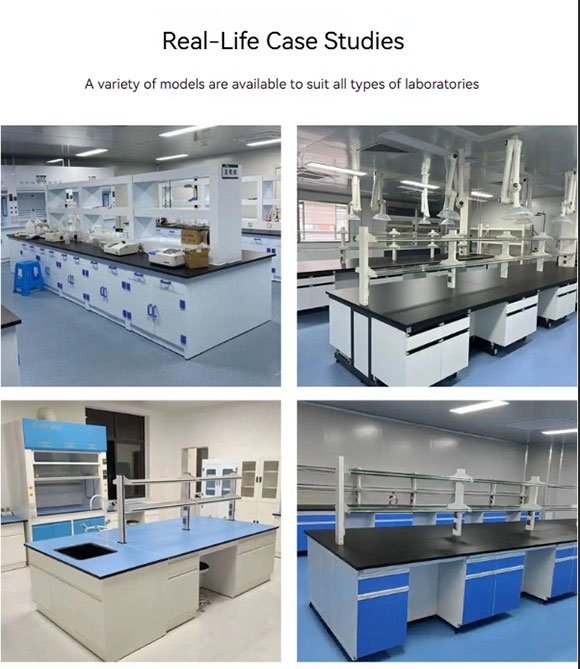
Steel-Wood vs All-Steel Lab Bench:What Each Frame Type Actually Is
Steel-wood isn’t wood. The name is misleading. The frame and cabinet shell are cold-rolled steel — same thickness, same welding, same powder coating as an all-steel unit. The “wood” part is the worktop: solid phenolic resin, kraft paper impregnated with thermosetting resin, fused under heat and pressure into one homogeneous slab. No particleboard core, no MDF, no laminate that peels. The only visible “wood-like” element is the cabinet door panels, MDF with a melamine face — or optionally, full steel doors if you prefer.
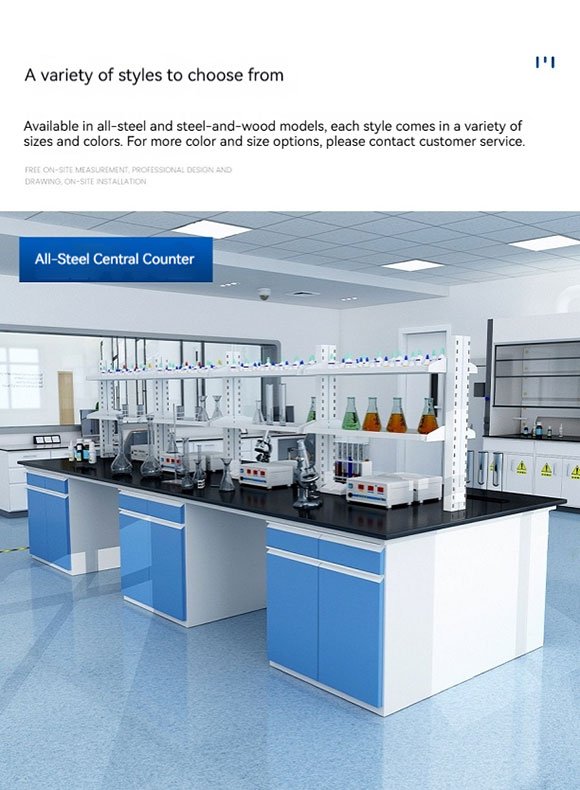
All-steel means exactly that. Frame, cabinet body, doors, drawers, and worktop — everything is steel. The worktop usually has a chemical-resistant coating or a separate steel sheet on top. No wood-based material anywhere.
Head-to-Head: 7 Things That Matter in a Real Lab
1. Cost
All-steel costs 60-100% more per linear meter than steel-wood. That’s not a small difference when you’re outfitting a 20-bench teaching lab or a hospital department wing.
Steel-wood: cold-rolled steel where it matters (frame, hinges, drawer slides), and phenolic resin where the chemistry happens (worktop). You’re paying for structural integrity and chemical resistance — not for steel on surfaces that never touch reagents.
All-steel: you’re paying for steel on every surface, whether it needs to be steel or not. Cabinet side panels, door faces, drawer fronts — steel that adds weight, cost, and zero chemical resistance over the alternatives.
2. Weight and Floor Load
A 3-meter all-steel bench can weigh 180-220 kg. Steel-wood of the same dimensions: 120-140 kg.
If your lab is on an upper floor of a converted building — common in university research wings and private testing labs — floor load rating matters. All-steel limits where you can place long runs of benching. Steel-wood doesn’t.
Shipping weight matters too. A 40-foot container of all-steel benches hits weight capacity before it fills up on volume. You pay for air. Steel-wood packs more units per container.
3. Static Electricity
This is the one most buyers don’t think about until it bites them.
All-steel benches conduct electricity. In a dry, air-conditioned lab, walking across a vinyl floor and touching a metal drawer handle generates a static discharge. If your lab runs sensitive electronics — analytical balances, spectrophotometers, PCR machines — that discharge can reset instruments or fry a circuit board.
Steel-wood: the phenolic resin worktop is inherently anti-static. The cabinet doors (if you choose the standard MDF-faced version) don’t conduct. The steel frame is grounded, so any residual charge dissipates safely. For electronics labs, semiconductor testing, and any workstation with sensitive instruments sitting on it, this alone decides the choice.
There’s a workaround for all-steel — anti-static mats and grounding straps — but that’s more stuff to buy, install, and maintain.
4. Dent Resistance
All-steel doors and drawer fronts dent. Not from abuse — from daily use. A lab stool pushed back against a cabinet. A gas cylinder trolley that clips the corner. A heavy ring stand dropped on a drawer face.
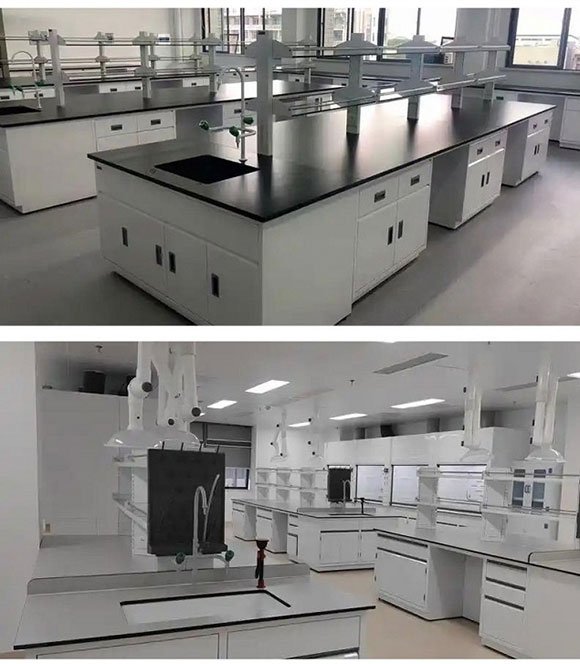
Steel-wood doors (MDF with melamine face) don’t dent the same way. They can chip if you hit them hard enough with something sharp, but the surface doesn’t deform from blunt impact the way 0.8mm steel sheet does. If a door does get damaged, replacing one MDF door panel is cheaper and faster than replacing a formed steel door.
5. Corrosion Resistance
Both types use the same steel for the frame — cold-rolled, phosphate-treated, powder-coated. Both resist normal lab humidity and chemical splashes the same way.
The difference is at the edges and joints. All-steel cabinets have more welded seams, more folded edges, more places where the powder coating is microscopically thinner. In a coastal lab — high humidity, salt in the air — those edges show rust spots faster than they should.
Steel-wood: fewer exposed steel surfaces overall. Cabinet sides and doors aren’t steel, so they don’t rust at all. The steel frame is fully enclosed behind panels, protected from direct splash and ambient moisture.
6. Acoustics
Walk into an all-steel lab and close a drawer. Now do the same in a steel-wood lab.
All-steel amplifies every sound. Drawers close with a metallic thud. Footsteps echo. A dropped beaker sounds like a car crash. In a teaching lab with 30 students, the noise level is genuinely distracting.
Steel-wood is quieter. MDF cabinet panels absorb sound instead of reflecting it. Drawers close with a solid, dampened feel — not silent, but not jarring. For labs where people work 8-hour shifts, this matters more than it sounds.
7. Aesthetics Over Time
All-steel looks clinical on day one. After three years: scuffs on the powder coating, small dents catching the light, paint wearing thin on high-contact edges. It’s not falling apart — it just looks tired.
Steel-wood ages differently. Melamine-faced doors wipe clean. Minor scratches on the phenolic top don’t show against the dark surface. A five-year-old steel-wood bench that’s been cleaned regularly still looks like year two.
So Which One Should You Buy?
Buy all-steel if: you’re outfitting a cleanroom where every surface must be metal for decontamination protocols. Or a heavy-industrial lab where worktops get hammered with impact loads — steel tops can take abuse that phenolic can’t. Or a lab where fire rating of every component is contractually required and wood-based materials (even fire-rated MDF) aren’t acceptable.
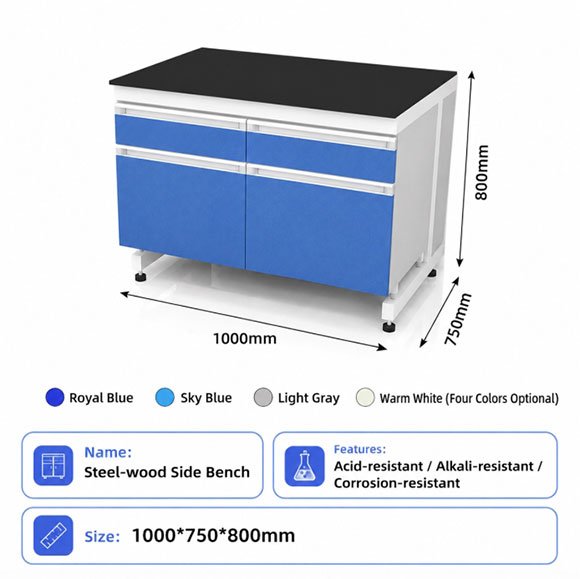
Buy steel-wood if: you’re running a standard chemistry, biology, QC, or teaching lab. You need chemical resistance on the worktop and structural strength in the frame, but budget and practicality matter. This covers 80% of labs worldwide — and it’s why steel-wood is the default choice in most markets across Europe, Southeast Asia, and the Middle East.
FAQ
Is steel-wood less durable than all-steel?
Not in any way that matters for a normal lab. The frame is the same 1.2mm cold-rolled steel with the same powder coating. The phenolic worktop is chemically tougher than a painted steel surface. Parts that take the load — frame, hinges, drawer slides — are identical between the two types.
Does steel-wood off-gas formaldehyde?
The phenolic resin worktop does not. It’s thermoset — no residual formaldehyde release. Cabinet door panels use E1-grade MDF, which meets EU emission standards. If your lab has a strict VOC policy, we can use all-steel doors on a steel-wood frame — best of both worlds.
What about termites and mold in tropical climates?
Phenolic resin is not wood — termites don’t eat it, mold doesn’t grow on it. MDF door panels are sealed with melamine on all faces and PVC edge-banding on all edges. No exposed wood fiber for moisture or pests to attack. We ship to labs in Indonesia, the Philippines, and coastal Africa — this is tested.
Can I mix steel-wood and all-steel in the same lab?
Yes. Many labs use steel-wood for general bench runs and all-steel only in specific zones — fume hood areas, solvent storage rooms, wash-down zones. We supply both types, so you’re not locked into one material.
What’s the price difference?
All-steel runs roughly 60-100% more per linear meter, depending on configuration. Contact us with your floor plan and we’ll quote both options side by side.
MOQ?
No fixed minimum. Single bench sample orders are fine. Bulk orders get better pricing.
Lead time?
Standard configurations: 15-20 days. Custom dimensions or mixed steel-wood/all-steel orders: 20-30 days.
Packaging?
KD knock-down. Moisture-proof film wrap, corner protectors, each component group packed separately with part numbers matching the assembly drawing.
Are you a trading company?
No. We are Luoyang Hengna Office Furniture Co., Ltd. — own brand, directly partnered with production facilities. You get factory-direct pricing without the middleman markup.
Need a quote? Send your lab floor plan. We’ll price both steel-wood and all-steel — you compare and decide. Response within 24 hours.