Static electricity kills electronics. A single discharge you can’t feel—under 3,000 volts—is enough to destroy a microcontroller or degrade a PCB trace. If your assembly bench isn’t grounded, every component you touch is a gamble. An ESD workbench built for electronics assembly takes that variable off the table. But not every bench labeled “anti-static” actually protects your work. Here are four questions to ask before you buy.
1. Does the Tabletop Actually Dissipate Static, or Just Resist It?
There’s a difference between “anti-static” and “static-dissipative,” and most bench listings blur the line. A true ESD workbench tabletop needs two properties:
- Surface resistance between 10⁶ and 10⁹ ohms: This is the IEC 61340-5-1 standard range. Below 10⁶, the surface conducts too fast and can create a spark hazard. Above 10⁹, static builds up faster than it drains. Ask the supplier for a surface resistance test report—not a brochure, an actual measurement sheet with date and test conditions.
- Grounded through a 1-megohm resistor: The tabletop laminate must connect to a common ground point via a coiled grounding cord with a built-in 1-megohm resistor. This resistor slows the discharge just enough to prevent a spark while still draining static to ground. Without it, you’ve got a bare wire to earth—and that’s a shock hazard.
Composite anti-static tabletops use a laminate with a conductive layer sandwiched inside. They’re durable and oil-resistant—good for repair benches where flux and solvent spills happen. But check the thickness. A 25mm composite top holds up to daily use; some budget benches use 18mm laminate that chips at the edges within a year.
2. Will the Pegboard Hold Static and Zap the Board I’m Working On?
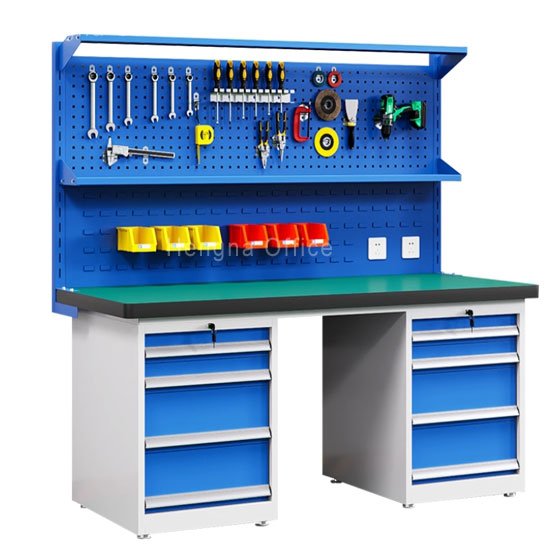
Metal pegboard seems innocent—it’s just a tool hanging surface. But in an ESD workspace, every metal surface is either part of the grounding system or a static threat. An ungrounded steel pegboard sitting above your anti-static tabletop is a capacitor waiting to discharge.
The fix is simple: the pegboard panel needs its own ground wire, tied to the same common ground point as the tabletop. Some manufacturers leave a pre-drilled grounding lug on the back of the pegboard frame. If it doesn’t have one, you’ll need to attach a ring terminal to a bare metal spot (sand off the powder coating at the contact point).
Practical check: Bring a surface resistance meter to your bench after assembly. Touch the probe to the pegboard, then to the tabletop. If the readings are more than one order of magnitude apart, your grounding path has a problem—likely a painted-over contact point or a loose ring terminal. Fix it before you put a board on the bench.
3. Are the Power Outlet and Light Safe in a Static-Controlled Area?
A workbench with built-in power sockets and an LED light is convenient—no extension cords snaking across the floor. But electronics assembly adds a wrinkle: the electrical system must coexist with the ESD grounding system without creating a short path.
Here’s what separates a properly designed ESD bench electrical setup from a generic one:
- Three-prong grounded outlets: The socket’s earth pin must connect to building ground (the green wire in your wall), not the ESD common ground point. These are two separate ground systems. The ESD ground drains static through a 1-megohm resistor. The electrical ground handles fault current. If someone ties them together, a wiring fault can send 120V through your wrist strap.
- Light fixture with no exposed metal: Adjustable LED light brackets are common on industrial workbenches. For ESD use, the bracket should be powder-coated or anodized to prevent it from becoming a floating conductor. If it’s bare metal, ground it.
- Switch placement away from the work surface: You don’t want to reach across a live PCB to turn on the light. Side-mounted or pegboard-mounted switches keep your hands in safe zones.
4. Does the Supplier Understand ESD Compliance, or Are They Just Selling a Blue Bench?
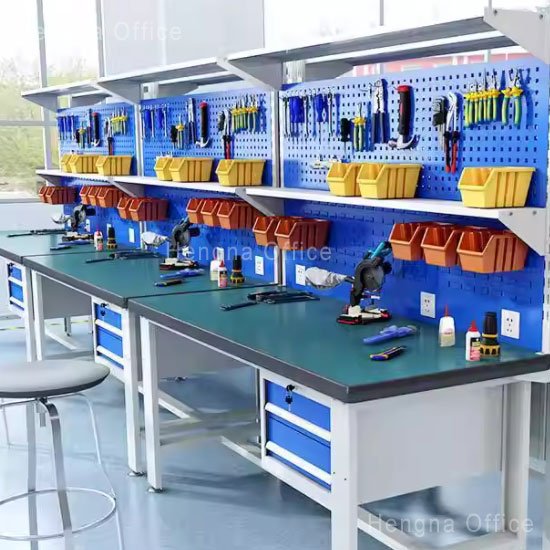
ESD workbenches look similar from 20 feet away. A blue powder-coated frame, a dark laminate top, a pegboard back. The difference is in the details that a non-specialist supplier won’t mention because they don’t know to mention them.
Send these three questions to any supplier before you place an order. The answers tell you everything:
- “What’s the surface resistance of your ESD tabletop, and can you send a test report?” A supplier who builds ESD benches answers with a number (10⁶-10⁹ Ω) and has a PDF ready. A supplier who just paints benches blue and calls them ESD will say “it’s anti-static” and change the subject.
- “Do you include a grounding kit—wrist strap, common ground point, tabletop ground cord, and pegboard ground wire?” The common ground point is the hub where all ESD grounds meet: tabletop, wrist strap, and pegboard. It should be a metal block with banana-jack sockets, mounted under the tabletop. If the bench ships without one, the supplier expects you to figure out grounding on your own.
- “Can you add a shelf above the pegboard for a monitor or test equipment?” Many electronics benches need an elevated shelf for an oscilloscope, a bench multimeter, or a second monitor. A factory that does OEM work says yes and quotes it. A reseller says “we only stock the standard configuration.”
Why a Cheap ESD Bench Costs More in the Long Run
A $400 ESD workbench from a general industrial supplier looks like a deal. A $700 bench from a manufacturer that specializes in ESD looks like an overpay. Two years later, the $400 bench has a tabletop laminate peeling at the edge—the conductive layer is exposed, and the surface resistance at that spot has dropped below 10⁵ ohms. That bench is now a conductor, not a dissipater, and it’s a safety liability.
The cost difference comes from three things: the laminate quality (25mm vs 18mm), the grounding hardware (included vs sold separately), and the frame build (powder-coated SPCC steel with full welds vs spot-welded thinner gauge). Amortized over a 7-year lifespan in a production environment, the premium bench costs about $100 per year. The cheap bench costs $400 to replace after year 3, plus whatever boards got zapped before someone noticed the static problem.
Electronics assembly and repair shops live and die by yield rates. An ESD workbench with a verified dissipative tabletop, a grounded pegboard, a proper common ground point, and an electrical system designed to coexist with ESD protection isn’t furniture—it’s process control equipment. Before you place an order, get the surface resistance test report, confirm the grounding kit is included, and make sure the supplier can answer question 1 without hesitating.