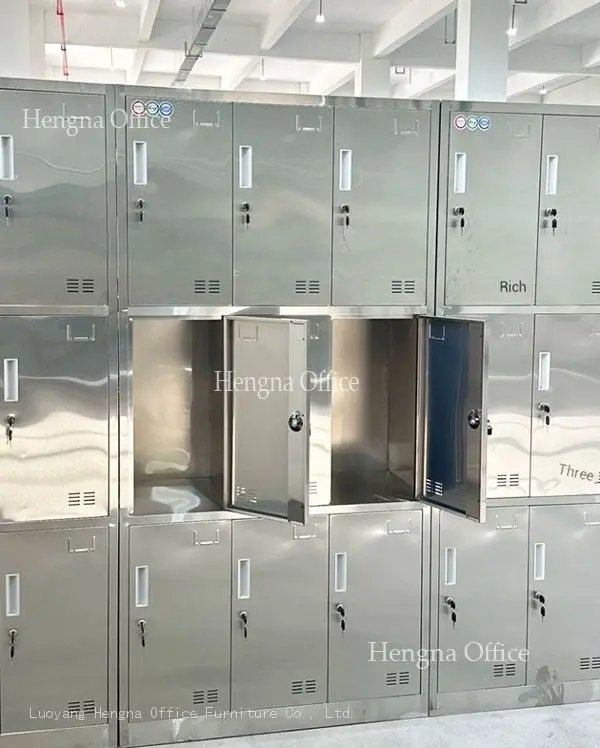
If you run a food plant, your locker room is the first line of your hygiene program, and most lockers are failing it. Staff walk in the door, hang up street clothes, and change into workwear, hairnets, and boots. The cabinet they use every shift gets splashed with wash-down water, sits in disinfectant fumes, and gets bumped by trolleys and boots all day. A painted steel locker survives that for maybe a year. Then the paint chips at the door edge, moisture gets under the coating, and a rust stain starts running down the front of a unit your auditor walks past. That is why food plant operators end up searching for a stainless steel locker that takes the wash-down without flaking. Here is the Q&A we would run against our own order before we placed it.
Why painted steel lockers lose in a food changing room
Cold-rolled steel with a powder coat is a fine locker for a dry office corridor. A food plant changing room is not that room.
Wash-down water. Changing rooms near processing floors get mopped, hosed, and disinfected daily. Water sits on the top and the base of every cabinet. On a painted locker, water sits on the coating. The day that coating is nicked — and it will be, a boot toe, a locker key, a trolley corner — moisture reaches bare steel and rust starts under the paint, where you cannot see it until it bubbles through.
Disinfectants. Chlorine-based cleaners and sanitiser vapours drift through the room. They attack an organic coating faster than they attack the metal underneath, so the surface grows dull and chalky long before it visibly fails.
Rust is an audit problem, not just an ugly one. In a facility running HACCP-based hygiene controls, a corroding cabinet in the staff area is exactly the sort of finding a hygiene auditor notes down. You fix it by replacing the whole unit, mid-shift, with a crew.
A stainless steel locker does not have a coating to fail. The surface itself is the protection, which is the whole reason the material moved out of kitchens and into food-area rooms.
The questions food plant managers actually ask
Do we need 304 stainless, or is 201 enough? This is the first question we get, and the honest answer depends on where the locker room sits. Our standard lockers are built in 201 stainless — a commercial-grade material that handles general indoor and semi-damp environments well. If your changing room sits next to a wash-down zone, is on the coast, or your quality team wants the more corrosion-resistant option for a food-grade area, we build the same locker in 304 stainless to order. We do not sell 201 and call it 304; tell us the room, and we will quote the grade that fits it.
What door count fits our headcount? A stainless steel locker food plant crews actually use runs from two doors up to fifteen doors per cabinet. Two-door and four-door units give each worker a full hanging compartment for a change of workwear. Higher door counts — nine, twelve, fifteen — compress each compartment into a small cubby for a bag and a coat, which suits plants with many short-shift staff. The four-door locker, standing 1850 mm high and 900 mm wide by 500 mm deep, is the unit most plants pick for a standard changing row.
Can we hose the room down without wrecking the cabinets? That is the point of stainless. Brushed or natural stainless surfaces wipe clean, and you can run normal disinfectant cleaning across the faces, the door edges, and the base without stripping a coating. No paint to chip, no film to peel, no rust line along the kick plate.
What about air moving inside the compartments? Ventilation holes are an optional feature on our lockers. Staff workwear goes into a closed compartment at the end of a shift, and the airflow option keeps it fresher than a sealed box. Ask for it when you specify the row; it is a standard option, not a custom build.
How do they arrive? Our lockers ship KD — knocked down, flat-packed, around 0.14–0.155 m³ per cabinet depending on the door count. That means one container holds far more lockers than assembled units, which is why freight lands at a fraction of what you would pay for pre-built cabinets. You assemble them on site, against the wall where the row will live.
The spec sheet
| Item | What we build |
|---|---|
| Material | 201 stainless standard; 304 stainless custom |
| Finish | Brushed / natural stainless, easy wipe clean |
| Height | 1850 mm across the range |
| Width × depth | 900 × 500 mm (2/3/4/6-door); 900 × 400 mm (9/12/15-door); 970 × 500 mm (glass-door unit) |
| Door counts | 2, 3, 4, 6, 9, 12, 15 per cabinet |
| Ventilation | Ventilated compartments available on request |
| Locking | Individual door locks |
| Packaging | KD flat pack, ~0.14–0.155 m³ per cabinet |
| Certification | CE |
| Warranty | One year |
FAQ
Is a stainless steel locker food-grade? Stainless steel is the standard material chosen for food-area and food-contact equipment because it resists corrosion, cleans easily, and does not chip into the product zone. We build in 304 for plants that want the more corrosion-resistant grade for hygiene-sensitive areas; the exact spec for your line is confirmed in the quotation.
How long do they last compared with painted steel? We will not quote you a lifespan number without knowing your wash-down routine. The difference is the failure mode: painted lockers fail by rusting out of chips, while stainless lockers do not have a coating to fail in the first place.
What is the minimum order and the lead time? Both depend on the door counts and the stainless grade you choose. Send us the headcount and the room — MOQ and lead time are confirmed in the quotation.
Can you silkscreen our logo on the doors? Yes. OEM and ODM work is standard for us, including silk-screened logos, custom packaging, and custom internal layout.
Do you supply CE documentation? Yes. CE documentation is available with the order.
Where do I get a price? Tell us how many staff, which door count, and 201 or 304. Quotes go out within 24 hours.
A closing note
A food plant changing room is not just storage — it is the room your auditor photographs. A rusting painted cabinet is a finding; a brushed stainless row that wipes clean every shift is background furniture nobody argues about. That is the whole job of food factory changing room storage: it holds coats and workwear quietly, and it survives the wash-down.
Cindy Steel Furniture — factory-direct stainless steel lockers, built for food factory changing rooms.