Walk into an older parish church and look for the case holding the chalice and the parish records. It is often a wooden cabinet from a previous century, with a lock that stopped working years ago and a shelf that sags under the weight of a single silver plate. The items inside are irreplaceable. The cabinet protecting them was chosen in a different era, for a different world.
Religious spaces hold objects that no ordinary storage can hold. A relic, a statue, a set of silver vessels, the offering trays of a busy temple — these are not inventory. They are treasured by a whole community, they are handled by many hands, and they must remain visible while staying protected. That combination is exactly what a purpose-built church display cabinet provides, and it is why churches, temples, and mosques are quietly becoming one of the most underserved markets for glass showcase manufacturers.
Why a Display Cabinet, Not a Shelf or Closet
Three forces work against sacred objects in everyday furniture.
Dust and climate. Incense smoke, candle soot, humid air, and monsoon seasons all attack metals and fabrics. An open shelf exposes relics to all of it. A sealed cabinet with a tempered glass front and a frame that closes evenly keeps the worst of it away.
Handling. Every time a treasured object is picked up to show a visitor, the risk of a scratch or a drop goes up. A glass-front display cabinet keeps the item viewable without being touchable — the best of both worlds for a community that wants to see its heritage, not lock it in a vault.
Accountability. Objects have a way of wandering in shared spaces. A cabinet with a proper key lock makes one person responsible, and makes it obvious when something is out of place. For parishes, temples, and mosques dealing with donations and historic gifts, that accountability is not optional.
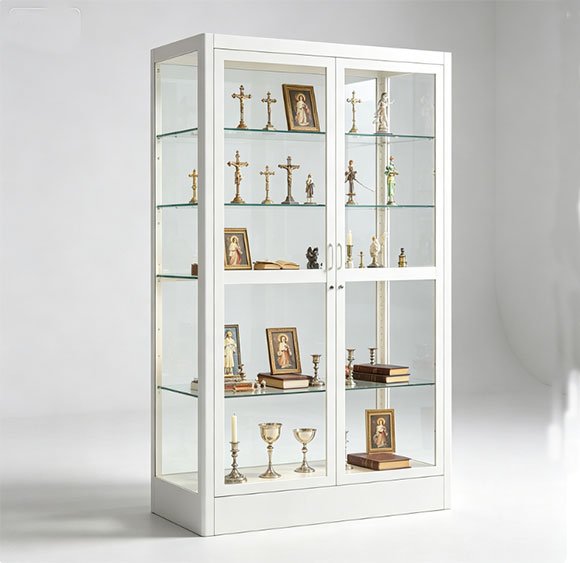
What to Look For in a Church or Temple Display Cabinet
Not every showcase suits a religious setting. The priorities are different from a retail store.
- Tempered glass, clearly specified. Tempered glass (heat-treated safety glass) resists impact far better than ordinary glass and breaks into blunt pieces rather than sharp shards. Ask for the thickness and the tempering to be stated in writing — 5 mm tempered glass is a common, dependable choice for this kind of cabinet.
- A frame that fits the room. Sacred interiors are traditional spaces. A heavy chrome frame shouts at a candlelit chapel; a clean black or white finished steel frame sits quietly in both modern and classic settings. Choose black for contrast and drama around bright metal objects, white for a light, open feel in smaller chapels.
- A real lock, with real keys. The lock should engage metal on metal, hold a key that does not rattle loose, and be replaceable if a key is lost. Avoid cabinets where the lock is a decorative afterthought on a glass door.
- A dust-aware fit. Look at how the doors meet the frame. Magnetic soft-close strips that pull the door evenly shut keep dust out far better than doors that simply rest against a stop.
- Adjustable shelving. A chalice needs height; a row of small reliquaries needs a low, close shelf. Adjustable glass shelves let one cabinet serve several display needs over the years.
Choosing a Size for the Space
Most religious buildings do not have spare floor space, which is why the standard floor-standing cabinet sizes translate well into sanctuaries, entrance halls, and side chapels.
| Space | What It Needs | Cabinet Type |
|---|---|---|
| Narthex / entrance hall | Visibility to every visitor, security through the day | Double-door floor cabinet, 1800–2000 mm tall |
| Side chapel or prayer corner | Intimate scale, one focal display | Compact double-door or tall single-door cabinet |
| Temple offering hall | Frequent access, orderly rows of items | Double-door cabinet with adjustable shelves |
| Narrow aisle or passage | No obstruction of foot traffic | Slim single-door cabinet |
| Chapter room or archive | Records, vestments, longer-term protection | Full-height cabinet with lockable doors |
A useful rule when measuring: pick the spot first, then the cabinet. Stand where the object will be seen from — the pew, the aisle, the offering queue — and check that the cabinet reads well from there. A display case that is beautiful up close but invisible from the congregation is doing half its job.
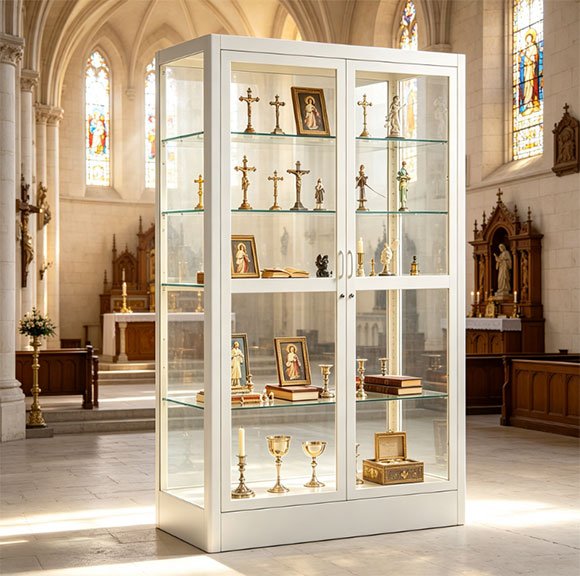
One Cabinet Style, Three Faiths
Religious display needs differ more by object than by faith, and the same well-made cabinet serves all of them with small changes in how it is used.
Churches. Silver vessels, memorial items, and historic records tend to be kept in the quieter parts of the building — a vestry, a side chapel, a donor recognition wall. Lockable glass doors keep the silver tarnish-free for longer and make the display part of the room instead of a hidden cupboard.
Temples. Offerings come and go constantly, so temple cabinets are worked hard: doors open all day, shelves take frequent use, and cleaning happens often. The priorities here are smooth hinges, shelves that wipe clean in seconds, and a finish that still looks dignified after years of incense smoke in the air.
Mosques. Historic manuscripts and gifts from visiting delegations often need long-term display with controlled access. A full-height cabinet with adjustable shelves and a single responsible key holder fits the pattern.
Practical Notes for Parish and Temple Committees
Buying for a religious institution is a committee process, and the questions are predictable. A few things worth knowing before the discussion:
- Measure twice, in writing. Note the ceiling height, the door widths on the route in, and whether the floor is level. A cabinet that cannot physically reach its corner is a very expensive lesson.
- Decide who holds the key before delivery, not after. One lock, one named custodian, a spare key in the safe.
- Plan for lighting separately. Display cabinets can be fitted with discreet LED strip lighting, which transforms how metal and glass objects read in a dim interior. If the budget is tight this year, choose the cabinet first — lighting can be added later.
- Buy from the manufacturer when the quantities make sense. Parishes ordering for a chapel, a hall, and a vestry at once — or diocese-level projects equipping several buildings — can order direct from the factory, keep the finish consistent across every cabinet, and replace a damaged unit years later from the same source.
Common Questions
Q: What kind of display cabinet works best for a church or religious space?
A: A floor-standing cabinet with 5 mm tempered glass, a steel frame in black or white, adjustable shelves, and a quality key lock. Prioritize dust resistance and even door closure over decorative features — sacred objects usually need protection and dignity more than display tricks.
Q: Can we display relics or historic items with lighting inside?
A: Yes. LED strip lighting adds almost no heat and makes gold, silver, and glass read beautifully against a dark interior. It can be fitted inside the cabinet without visible wiring, and it can be added later if the initial budget does not include it.
Q: We are in a humid climate. Will the cabinet protect what is inside?
A: A well-sealed cabinet with magnetic door closure keeps humid air, dust, and incense smoke away far better than open shelving. For very humid regions, add a simple moisture absorber inside the cabinet and refresh it seasonally — the sealed interior lets a little go a long way.
Q: How do we order for a temple or church in Africa, Asia, or the Middle East?
A: Order directly from the factory with your measurements and the number of units. Cabinets are packed for sea freight and consolidated per project, so a church, a mosque, or a temple can equip several display points in one shipment. Ask for the current production schedule before planning an installation date.
The Short Version
Sacred objects need three things: visibility, security, and protection from dust and climate. A floor-standing steel-frame cabinet with tempered glass, adjustable shelves, and a dependable key lock delivers all three. Choose black or white to match the space, pick the size by standing where people will view it, and plan lighting as an easy later addition. Buy direct for the best consistency when equipping more than one display point — and keep one named key holder for every cabinet.
Equipping a church, temple, or mosque with secure display storage? Send us the space measurements, what will be displayed, and how many cabinets you need — we will recommend sizes and configurations, factory-direct.