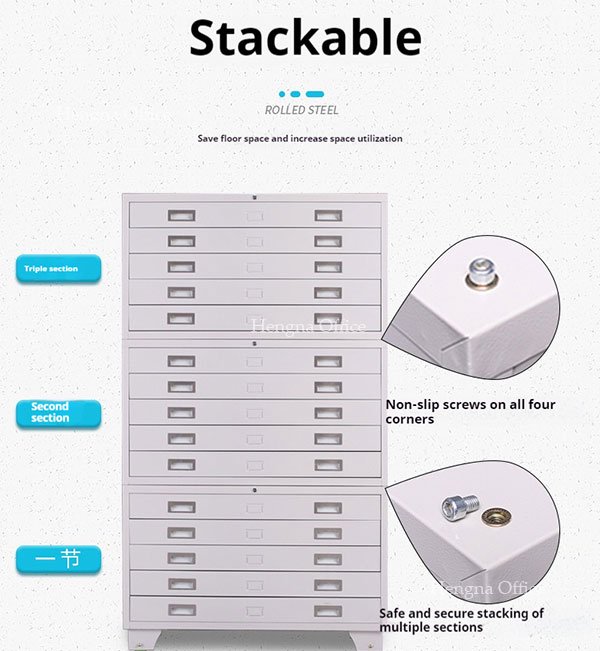
Libraries never have enough floor space. Every renovation plan starts the same way: shelves go up, reading tables get squeezed, and somewhere a card catalog has to live. Yet the card index has not disappeared — periodical rooms, local history collections, government document reading rooms, and special collections still run on card drawers because a card is faster to browse than a screen when you are searching by subject, cross-reference, or accession number. The problem is where to put the cabinets without stealing another square metre from readers. That is what a compact card file cabinet solves, and we build them from the factory floor.
Why a library chooses a 620 mm depth instead of a full lateral cabinet
The first space question is depth, not height. A standard lateral file cabinet sits 900 mm deep. Run a row of those along a wall and you lose almost a metre of floor in front of them just to pull a drawer. The narrow compact version runs 620 mm deep, and the difference is real floor space: roughly 280 mm less wall reach per cabinet. In a reading room where every metre is a seat, that is the difference between a row of cabinets and a row of cabinets plus two study tables.
The 620 mm depth still takes A4 folders, hanging files, and standard index cards. You are not giving up capacity for the slimmer footprint — you are giving up the empty rear section that a deep cabinet carries for oversized files most libraries never store.
How many drawers should a library take — the 3 drawer answer
The compact card file cabinet 620 mm depth 3 drawer model is the one most librarians land on, and the reasons are practical.
A 3-drawer narrow unit stands 1020–1030 mm tall. That is low enough to reach the top drawer standing, no step stool needed, which matters when a student pulls a drawer during open hours. It divides the card index into three clean groups — say, periodicals A–M, N–Z, and special collections — without the label hunting that a 5-drawer tower forces. Each drawer holds roughly 200 cards, so a 3-drawer unit covers about 600 card groups per cabinet.
A 2-drawer unit at 720–730 mm tall fits under a window or beside a circulation desk. A 4-drawer at 1320–1330 mm suits a closed stacks reading room where staff pull the cards. For most public and school libraries, though, the 3 drawer is the sweet spot between reach, labelling, and floor use.
What the circulation desk asks about locks
Libraries hand keys to a lot of people — librarians, student assistants, night staff. The lock has to survive that. Our cabinets use a steel core central lock: one key locks all drawers on the unit. And keys from the same batch do not open another cabinet, so a lost key for Cabinet A does not expose the whole card row.
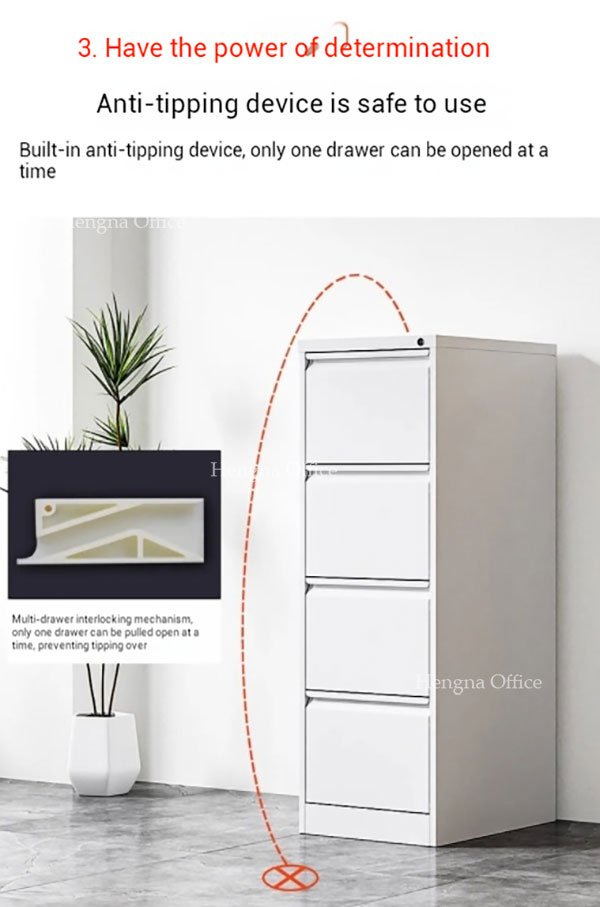
There is an anti-tip interlock too. In a busy reading room someone will pull two drawers at once while balancing a stack of books. The interlock stops that — only one drawer opens at a time, so a loaded cabinet never tips forward into a reader.
How the cabinet holds up in a public room
Library furniture takes daily abuse: hands on handles, drawers slammed, carts bumped against the row. The cabinet is cold-rolled steel sheet, 0.6–0.8 mm thick, with an electrostatic powder coat in white, grey, or two-tone. The arched pull handle is rounded so it does not catch a sleeve or scratch a forearm. Label holders sit on each drawer face, so the subject ranges stay legible for years instead of falling off as taped paper.
If a service point needs to move the cabinet between rooms, a mobile version with lockable swivel casters is available.
The spec sheet
Here is the compact series we build, in plain numbers:
| Specification | Value |
|---|---|
| Material | Cold-rolled steel sheet, 0.6–0.8 mm |
| Depth choice | 620 mm narrow (compact) / 900 mm wide lateral |
| Standard library pick | 3-drawer narrow, H1020/1030 × W460 × D620 mm |
| Other narrow sizes (W460 × D620) | 2-drawer H720/730, 4-drawer H1320/1330, 5-drawer H1631 |
| Slides | 3-section ball bearing, full extension |
| Load per drawer | Around 35 kg |
| Cards per drawer | Around 200 index cards / folders |
| Lock | Central locking, steel core, same-batch keys non-cross-opening |
| Safety | Anti-tip interlock — one drawer at a time |
| Finish | Powder coat, white / grey / two-tone; arched pull handles |
| Mobile option | Lockable swivel casters |
| Structure | KD flat pack |
| Warranty / certification | 1-year warranty, CE |
Dimensions carry a ±10 mm tolerance; confirm against the physical drawing in the quotation.
FAQ
Why not just use open shelving for the card indexes? Cards on open shelves get pulled, dropped, and re-sorted wrong. Drawers with label holders keep each subject range sealed and browsable without disturbing the rest of the index.
How much floor depth does the 620 mm cabinet need in front? Plan the aisle for a fully pulled drawer plus a standing person. The slimmer 620 mm body itself leaves noticeably more walking room than a 900 mm lateral unit in the same row.
Can students reach the top drawer? The 3-drawer unit tops out at about 1030 mm, which most adults reach standing. If a room serves younger readers, drop to the 2-drawer unit at 720–730 mm.
Do keys cross between cabinets on one row? No. Lock cores are grouped per batch, so one key opens only its own cabinet.
Can the cabinet move between rooms? Yes, the mobile version on lockable swivel casters lets a staff team shift the row during renovations.
How long is delivery, and how do I price it? Standard models ship in 20–30 days. Send us the drawer count, quantity, and delivery port — FOB or CIF from Qingdao or Tianjin — and the quote goes out within 24 hours.
A final buying note
A library buys furniture for decades of hands on it. A compact 620 mm card file cabinet, 3 drawers of full-extension 35 kg slides, central lock with non-cross-opening keys, and an anti-tip interlock, takes the card index off the reader’s path and keeps it fast to browse. That is the whole job of library index card storage floor space: the cards stay findable, and the floor stays for the readers.
Cindy Steel Furniture — factory-direct steel card file cabinets, built for library index card storage floor space.